

By What Standard? A Friendly Response to Alex Kocman
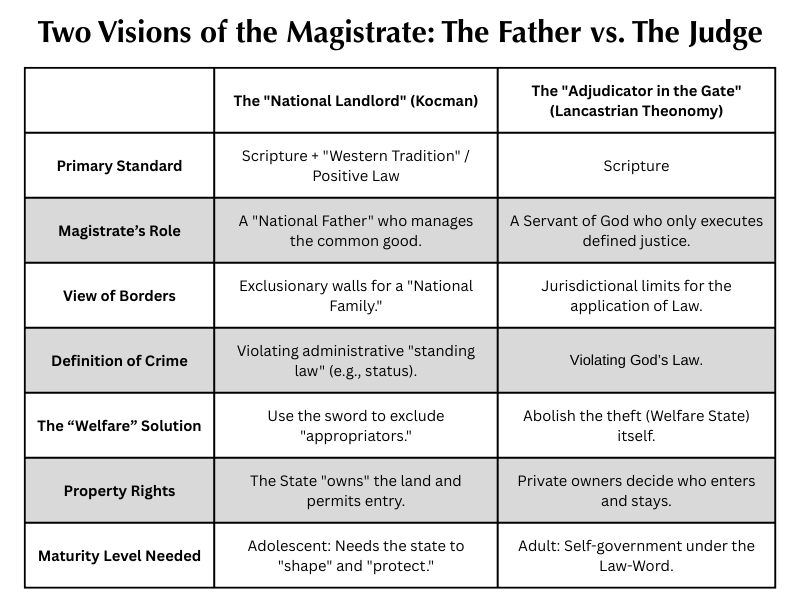
In his article, By What Standard? ICE, COVID, and Romans 13, Alex Kocman attempts to solve a perceived inconsistency in Christian resistance. He asks how one can support resistance to COVID mandates while condemning resistance to federal immigration enforcement. His answer is that COVID mandates were extra-jurisdictional, while immigration enforcement is a “standing law” that reflects “God’s natural ordering.”
While I appreciate Kocman’s call for consistency, his argument rests on a fundamental misunderstanding of the magistrate’s authority and a misapplication of biblical “boundaries.”
1. The “Boundary Marker” Fallacy
Kocman cites Acts 17:26 and Deuteronomy 19:14 to argue that borders and immigration control are part of the magistrate’s “prescribed sphere.” This is a classic category error.
- Acts 17:26 is a descriptive statement about God’s sovereign providence over history and geography; it is not a prescriptive mandate for a magistrate to build a wall or issue visas.
- Deuteronomy 19:14 (“You shall not move your neighbor’s boundary mark”) is about private property theft. It forbids a man from secretly enlarging his field at his neighbor’s expense.
To take a law protecting private property and turn it into a warrant for national border bureaucracy is the essence of statism. It assumes the State is the “Universal Landlord” who owns all the land and can decide who walks on it. In the biblical view, the magistrate doesn’t own the soil; families and individuals do. If an immigrant buys a field from a willing seller, whose “boundary marker” has been moved? None.
2. Is “Illegal Presence” a Biblical Crime?
Kocman claims that “illegal immigration violates both civil law and moral law,” labeling it as “trespass” and “theft.” By what standard does he make this claim? Theft requires a victim. Who is the plaintiff in the case of a non-violent immigrant working a job?
Trespass requires a violation of private property. If a man enters the country and stays on a friend’s farm or a rented apartment, he has trespassed against no one.
Kocman is doing exactly what the COVID bureaucrats did: he is treating Positive Law (man-made administrative statutes) as if it were Moral Law (God’s definitions of sin). He rightly notes that “gathering for worship… does not violate natural law.” But neither does “moving from one place to another.” If the magistrate draws the sword against someone who has not committed a biblical crime (idolatry, murder, rape, etc.), he is not being “God’s servant for good”; he is being a terror to a good (or at the very least “neutral”) conduct.
3. The COVID Paradox
Kocman argues that COVID mandates were wrong because they were “administrative edicts issued without proper legislative authority.” Yet, he defends ICE enforcement as “standing immigration law” within the state’s “prescribed sphere.”
This is a distinction without a difference. Both are systems of Positive Law—man-made rules added to the perfect Law of God. If a magistrate has no authority to tell a church it cannot meet (because God hasn’t given him that authority), by what logic does he have the authority to tell a man he cannot work or live in a certain zip code?
The “Equal Weights and Measures” Kocman calls for would require him to admit that the magistrate has no more authority to stamp a passport than he has to mask a face. Both are attempts to regulate human life beyond the adjudicative scope of the Sword.

4. The Nature of Resistance
Kocman is right to condemn “private violence” and “lawless rebellion” in the Minneapolis case. Theonomists are not anarchists. We do not believe in “de-arresting” people through street brawls.
However, we must be honest: if the ICE agents were arresting someone for a “crime” that God does not recognize (simple presence), they were technically the aggressors. The solution isn’t street violence; it is the interposition of lower magistrates and the refusal of the people to fund the bureaucracy. But Kocman cannot see the agents as aggressors because he has already accepted the statist premise that “The Law of the Land” (the US Code) is synonymous with “The Law of God.”
5. The Welfare Trap: Solving Theft with More Statism
Kocman argues that illegal immigration involves the “appropriation of goods and services to which one has no lawful claim.” He is, of course, referring to the welfare state—taxpayer-funded healthcare, education, and subsidies.
While we must agree that the welfare state is a grievous violation of the Eighth Commandment, Kocman’s solution is a theological non-sequitur. He is effectively saying: “Because the State has stolen money from the citizen to create a welfare magnet, we must now give the State the power to regulate human movement to protect the stolen loot.”
This is doubling down on statism. If a homeowner leaves a pile of stolen jewelry on his front porch and it attracts local thieves, the solution is not to grant the neighborhood watch the power to arrest anyone walking down the sidewalk. The solution is to give the jewelry back and clear the porch. In a biblical society, the “theft” Kocman fears would be impossible because the welfare state would not exist. There would be no “free” goods to appropriate. By using the existence of the welfare state to justify ICE’s extra-biblical authority, Kocman is letting the State’s previous sins dictate its current powers.
The theonomic solution is simpler and biblical:
- Stop the Theft: Abolish the welfare state and all unbiblical subsidies.
- Restore Property Rights: Allow individuals to decide who may enter their land and consume their resources.
- Stop the Sword-Inflation: Do not grant the magistrate a “new” power to police borders just because he failed to stop his “old” habit of stealing from the productive to give to the non-productive.
You don’t fix socialist practices by adding regulatory practices; you fix them by repenting of statism altogether. If we have “one law for the native and the sojourner,” and that law forbids the state from stealing, the “appropriation” problem vanishes without a single deportation.
6. The Natural Filter of Justice
What the statist fails to see is that God’s Law provides a far more effective—and just—filter for immigration than any federal bureaucracy ever could. We do not argue for “open borders” in the sense of lawless chaos; we argue for the Natural Filter of Justice. When a nation enforces the Eighth Commandment by abolishing the welfare state, the “lazy” are naturally deterred. When a nation protects the absolute property rights of its citizens, “forced integration” becomes impossible. When the magistrate punishes actual crimes like theft, murder, and idolatry with biblical swiftness, the “criminal” finds our land a terror rather than a haven. This is regulation by righteousness, not by registration. It is the mature approach that trusts the secondary effects of God’s Law to order society, rather than trusting a fallen bureaucrat to manage the demographics of the nation.
Conclusion
Alex Kocman’s attempt to find a “standard” for ICE ends up being a standard of pragmatic management, not judicial justice. He wants to use the magistrate’s sword to manage the unintended consequences of a socialist system. He asks, “By what standard?” and then proceeds to answer using the Western Legal Tradition rather than God’s Law. He admits that the state “does not determine the standards of justice but administers justice under God.” Yet, he then allows the state to invent a whole category of “crime” (immigration status) that appears nowhere in the Bible.
But a friendly reminder to our brother: The magistrate’s job is not to manage the “Common Good” through population control; his job is to execute God’s wrath against the evildoer. If the state is the one doing the “appropriating” via taxes, then the state is the one that needs to be restrained, not the man crossing a jurisdictional line.
True “Equal Weights” means we stop making excuses for the federal hammer just because we happen to like the nail it’s hitting this week. True “Equal Weights” means we judge the ICE agent by the same Bible we used to judge the COVID inspector. If God didn’t legislate it, the magistrate can’t enforce it with a sword. Until we grasp that, we are just arguing over which flavor of statism we prefer.