
John Eliot’s Christian Commonwealth and Lancastrian Theonomy
I was first introduced to John Eliot’s The Christian Commonwealth through Luke Saint’s book The Sound Doctrine of Theocracy, which includes an excerpt from Eliot’s work in its appendix. That excerpt was enough to convince me that Eliot deserves a wider hearing. Eliot’s little book — written in the late 1640s, published in London in 1659, and suppressed by order of the Massachusetts General Court in 1661 — is a remarkable document. It has been called the first book of political theory written by an American, and, with no small irony, might be the very first book ever banned by an American government.
But my interest in Eliot is not merely antiquarian. One of the recurring charges leveled against the position we have come to call Lancastrian theonomy — the conviction that God’s revealed Law-Word is sufficient legislation for civil society, requiring adjudication by judges rather than the perpetual manufacture of new law by legislatures — is that it is a novelty. We are told it has no history, no tradition, no precedent among the people of God. The critique is mistaken on its own terms (Scripture, not tradition, is our standard, and the Reformation itself would have died in its cradle if majority consensus were the test of truth). But it is also mistaken as a matter of historical fact. Three and a half centuries ago, a Puritan missionary on the edge of the American wilderness sat down with his Bible and asked the very question we are asking: if a people were free to choose their civil government from scratch, what would God have them build? His answer will sound strikingly familiar.
This article has two aims. The first is to give the reader unfamiliar with Eliot a faithful overview of who he was and what The Christian Commonwealth actually argues. The second is to demonstrate that the core commitments of Lancastrian theonomy — the sufficiency of Scripture as civil law, the rejection of human legislation, and the centrality of adjudication — were articulated with remarkable clarity in 1659. We are not inventing something new. We are recovering something old.
Who Was John Eliot?
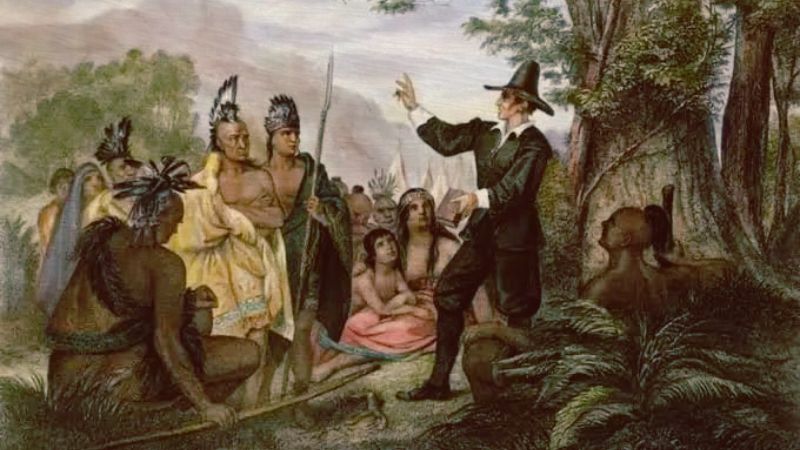
John Eliot (1604–1690) was a Puritan minister, teacher of the church at Roxbury in the Massachusetts Bay Colony, and the man history remembers as the “Apostle to the Indians.” He devoted decades of his life to evangelizing the native peoples of New England, mastering the Algonquian language and producing the first Bible printed in America — not in English, but in the Massachusett tongue.
Eliot’s missionary labors are what occasioned The Christian Commonwealth. As converted natives embraced the gospel, they desired, in Eliot’s words, “to leave their wild and scattered manner of life, and come under Civil Government and Order.” Here was a people with no existing constitution, no inherited legal tradition, no entrenched political class — a genuinely blank slate. Eliot recognized the weight of the moment and made a solemn vow to the Lord concerning them: “I would endeavour with all my might, to bring them under the Government of the Lord only: Namely, that I would instruct them to imbrace such Government, both Civil and Ecclesiastical as the Lord hath commanded in the holy Scriptures; and to deduce all their Laws from the holy Scriptures, that so they may be the Lords people, ruled by him alone in all things.”
Note carefully what Eliot did not do. He did not reach for English common law. He did not draft a charter modeled on the colonial governments around him. He did not convene the wisest men he knew to legislate prudently for a new society. He went to the Scriptures, convinced that God had already provided everything a civil society requires. The “praying towns” he organized among the converted natives were governed on this model.
In the late 1640s, Eliot adapted his plan for English use and sent the manuscript across the Atlantic, where the turmoil following the execution of Charles I had opened the question of England’s civil constitution in a way it had not been open for centuries. The book appeared in print in 1659, after Cromwell’s death and before the Restoration. Its timing proved fatal. When Charles II took the throne, Eliot’s declaration that Christ — not any Stuart — was the rightful heir of the English crown became politically intolerable. The Massachusetts General Court ordered the book “totally suppressed” in 1661, and Eliot, under evident duress, issued a public retraction acknowledging monarchy as “not only a lawfull, but an eminent forme of government.” The retraction concerned the political offense given to the restored monarchy; it should be read in that light, as the act of a colony desperate to keep its charter, rather than as a considered repudiation of the book’s biblical argument. Nine copies survive.
Christ the Only Rightful Heir
The preface is the most radical portion of the work, and it announces the thesis without apology. England was consumed with the question of the “rightful Heir of the Crown,” and Eliot answered: “Christ is the only right Heir of the Crown of England, and of all other Nations also.” He pleaded with the English nation to “set the Crown of England upon the head of Christ, whose only true inheritance it is,” and pressed the point in a triad drawn from Isaiah 33:22: “Let him be your JUDGE, Let him be your LAWGIVER, Let him be your KING!”
For Eliot, this was no pious abstraction. Christ reigns, he wrote, “when all things among men, are done by the direction of the word of his mouth: his Kingdom is then come amongst us, when his will is done on earth, as it is done in heaven.” The practical entailment is that a nation submitted to Christ takes both the form of its government and the content of its laws from Scripture alone. Eliot was explicit that the alternative — searching “humane Polities and Platformes of Government, contrived by the wisdom of man” — was precisely what the Lord was calling England to abandon:
“There is undoubtedly a forme of Civil Government instituted by God himself in the holy Scriptures; whereby any Nation may enjoy all the ends and effects of Government in the best manner, were they but persuaded to make trial of it. We should derogate from the sufficiency and perfection of the Scriptures, if we should deny it.”
Mark that final sentence. Eliot grounds his entire civil polity in the sufficiency of Scripture — the same doctrinal soil in which Lancastrian theonomy is planted. To claim that God’s Word requires supplementation by human legislation is, on Eliot’s terms, to derogate from its perfection. He even anticipated the objection from 1 Samuel 8: for a Christian people to pattern their government after the nations of the world, when Christ “intends to Rule them himself, by his own Divine Patern and Direction,” is to repeat Israel’s sin in demanding a king like the nations.
The Covenant and the Only Magna Charta
The body of the work opens with the requirement that a people covenant with the Lord in their civil society, not merely their church society. And the substance of that covenant is worth quoting at length, for it contains the legal heart of the whole system. The covenanting people receive from the Lord “both the platform of their civil Government, as it is set down (in the essentials of it) in the holy Scriptures; and also all their Laws, which they resolve through his grace, to fetch out of the Word of God, making that their only Magna Charta; and accounting no Law, Statute or Judgement valid, farther then it appeareth to arise and flow from the Word of God.”
All their laws. Their only Magna Charta. No law, statute, or judgment valid except as it arises and flows from the Word of God. It would be difficult to state the sufficiency of Scripture for civil law more forcefully. There is no provision here for a legislature generating new binding statutes from natural law, national custom, or prudential calculation. The Word is the law book, full stop.
The Platform: Exodus 18 and the Rulers of Tens
From this foundation Eliot builds his governmental structure, and he builds it from Exodus 18 and Deuteronomy 1 — the Mosaic order of rulers of tens, fifties, hundreds, and thousands, chosen by the people themselves. Every ten men choose a ruler of ten; five orders of ten choose a ruler of fifty; and so upward, culminating (for greater nations) in a superior order of rulers of myriads and a Supreme Council patterned on the seventy elders who stood with Moses.
The details of the arithmetic need not detain us, though Eliot works them out with an almost mathematical delight. What matters is the function of these rulers. They are, from bottom to top, judges. The ruler of ten sits at appointed times “to hear and determine Causes of Justice.” The courts of six, three, and eleven exist to try cases, hear appeals, and see the sentence of God’s Word executed. Difficult cases ascend, exactly as in Exodus 18, from court to court — and when a case is too hard even for the highest human council, Eliot’s instruction is stunning in its fidelity to the pattern of Moses: “the Scriptures are the Mouth of God, at which they must enquire, and by the guidance thereof determine of all Cases, so far as the Lord giveth light; and until the mind of God be known, the Case must stay, whatever it be.” He cites Numbers 15:34, where the sabbath-breaker was held in ward “because it was not declared what should be done unto him.” Where God has not spoken, the judge does not improvise. He waits.
The entire apparatus, in other words, is a judiciary. There is no parliament in Eliot’s commonwealth. There is no legislature. There is a graduated system of courts, staffed by rulers whom the people choose, applying a law they did not write.
The Law and Its Application
If the preface contains Eliot’s boldest rhetoric, the brief final chapter contains his most important jurisprudence, and it reads as though it could have been written for our present debates. Having described the platform of government, Eliot turns to the laws by which the rulers are to govern: “The written Word of God is the perfect Systeme or Frame of Laws, to guide all the Moral actions of man, either towards God or man: the Application whereof to every Case according to its circumstances, must be by the wisdom and discretion of the Judges, guided by the light of the Scriptures, and a pure Conscience.”
Here is the whole Lancastrian position in a single seventeenth-century sentence. The Word is the perfect system or frame of laws — complete, needing no statutory supplement. And the mechanism by which that law meets the messy particulars of human life is not legislation but application to every case according to its circumstances by the wisdom and discretion of judges. Eliot then defines judgment itself in precisely these terms: “The judgement and determination of a Cause, is nothing else, but the particular application of the Cause, according to all its circumstances, unto the Rule and Standard of Gods Word.”
One further detail deserves notice. In the closing lines of the book, Eliot addresses the status of outsiders: “All Strangers, are to be accounted under the Government of those Orders where they reside, and where their business lieth; so as to have the benefit of the Government of the Lord, as our own people have.” The stranger residing in the commonwealth stands under the same law and enjoys the same justice as the native — a thoroughly biblical instinct (Lev. 24:22).
Eliot and Lancastrian Theonomy
Let the parallels now be drawn together plainly. Lancastrian theonomy holds that God’s Law-Word is sufficient for civil justice; Eliot held that to deny a divinely instituted civil order in Scripture is to “derogate from the sufficiency and perfection of the Scriptures.” Lancastrian theonomy holds that no new binding law is to be manufactured, Scripture being the only valid legal standard; Eliot’s covenant makes the Word the people’s “only Magna Charta” and accounts “no Law, Statute or Judgement valid” except as it flows from that Word. Lancastrian theonomy holds that the magistrate’s work is adjudicative — hearing cases and applying God’s revealed law to their particular circumstances; Eliot’s entire platform is a system of courts, and his definition of judgment is nothing other than “the particular application of the Cause… unto the Rule and Standard of Gods Word.” Lancastrian theonomy holds that where God has not spoken, the magistrate has no warrant to invent; Eliot’s judges, faced with a case beyond the light of Scripture, must let “the Case stay, whatever it be.” At almost every load-bearing point, the seventeenth-century missionary and the position we advocate stand on the same ground.
Honesty requires acknowledging the differences as well, and there are real ones. Eliot’s Supreme Council is assigned care for public welfare, trade, fishing, tillage, and learning — a broader portfolio than a strictly retributive magistracy. His elaborate decimal structure of rulers is pressed from Exodus 18 with more constitutional rigidity than the text may bear, and his fervent millennial expectation colors the whole work. Eliot was a man of his moment, and we are not obliged to follow him in every particular. But these are differences at the edges. The trunk of the tree — Scripture as sole and sufficient civil law, administered through adjudication rather than augmented through legislation — is the same trunk.
The Charge of Novelty
Which brings us back to where we began. When critics allege that our position is a recent invention with no footprint in church history, John Eliot is a standing refutation. And he did not stand entirely alone: his contemporary William Aspinwall, another New Englander, published a treatise in 1656 whose title alone makes the point — The Legislative Power is Christ’s Peculiar Prerogative. Among the generation that planted churches and commonwealths in New England, there were men who looked at the question of civil law and concluded that God had already legislated, perfectly and finally, and that the whole duty of man in the civil sphere was to judge righteously by that legislation.
Was theirs the majority report? No — and we have never claimed otherwise. Christendom largely took the other road, the road of Christian princes and Christian parliaments generating ever-expanding codes, and we are living in the far country to which that road leads. But a minority report is not a nonexistent one. The claim on the table was never “most of our fathers said this.” The claim is that Scripture teaches it — and that when a faithful Puritan, confronted with a people genuinely free to build their civil order from the ground up, searched the Scriptures to see what God would have them build, he found what we have found. That is worth something. Not as an authority above the Word, but as a witness to it.
Eliot closed his preface with a prayer that the Lord would bow divided hearts “to make CHRIST their LAW-GIVER, and JUDGE, and KING, in whom alone they shall finde settlement and assured peace.” Three hundred and sixty-seven years later, that remains the prayer. The Crown belongs to Christ. The law book is already written. What the nations need is not new legislation but righteous judges — and the faith to believe that the Law of the Lord is perfect.