
Is Bowing to Allah a Capital Crime?
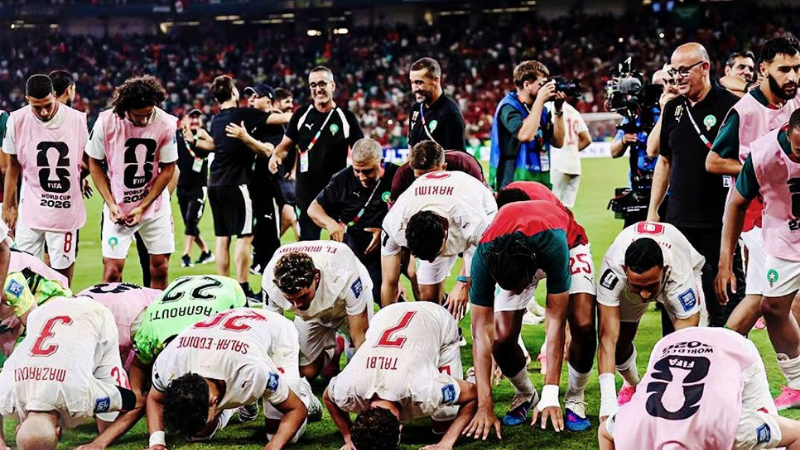
In a recent episode of The Lancaster Patriot Podcast, I took up a question prompted by a soccer match in the World Cup. When Morocco defeated the Netherlands on June 29, the Moroccan players dropped to the turf in the sujood, the Islamic prostration, and prayed to Allah before a watching world. I used that image to press a pointed question about God’s Law: in a nation actually ordered under biblical law — a Christian republic in the fullest theonomic sense — would that public act of false worship constitute a capital crime? My answer, worked out from Deuteronomy 13, Deuteronomy 17, and Leviticus 24, was no: not the bare act of bowing in prayer to a false god. I argued that God’s Law is a bit narrower when it comes to this matter.
That episode drew a serious and gracious challenge from a Christian brother in the YouTube comment section — among the most thoughtful responses I have received on any subject. He was charitable where he disagreed, careful in his handling of Scripture, and honest about the places where the evidence is genuinely difficult. He is precisely the kind of interlocutor who makes this labor worth doing: a Christian who takes the Law-Word of God seriously enough to wrestle with it rather than merely to cheer or jeer. I suspect there is some slight nuance between me and other members of Future of Christendom, but what follows is my personal attempt to answer the viewer’s critique.
Where We Agree
I believe God’s penology is perfect, that His capital sanctions are just, and that a nation ordered under His Law would rightly enforce them without apology. If a Muslim in a Christian republic stood up and called on the people to abandon the Law-Word of Christ and submit to Sharia law that is enticement to idolatry, that is treason against the divine constitution, and yes, it is a capital crime. On that we agree. I am not carving out some safe harbor where false religion may work to topple Christ’s kingdom untouched. The magistrate bears the sword, and against that man he would rightly bear it.
So that is not our disagreement. The question on the table is narrower: what about the bare act of a man praying to his false god — the sujood on the pitch, or the bowed head at a restaurant table — and, more broadly, the simple public display of one’s faith, apart from any clear soliciting or subversion? Is that, by itself, the act God’s Law arms the magistrate to answer with death? That is where I (for the moment) might part company with some able brothers within the theonomic camp, and that is the only question I am pondering here.
The Objection
The brother’s central contention was that I had been too quick to acquit. If the Moroccans’ act were brought before a magistrate in a theonomic society and proven, he argued, it would “most likely be [punished] by capital punishment.” He grounded this in two passages I had not treated at length: Numbers 15:27–31 and Deuteronomy 17:8–13, both of which address the “high-handed,” or presumptuous, sin.
His argument advanced along several lines. First, Numbers 15 pronounces that the one who sins “with a high hand” “reviles the LORD” and shall be “cut off from among the people.” He observed, fairly, that the passage moves from the act to the label of blasphemy — it does not say the man blasphemes and that his blasphemy is high-handed, but rather that he acts presumptuously, and that is the reviling. From this he asked whether “what the Moroccans did was clearly a presumptuous sin — especially considering that they did it in front of the whole world.”
Second, he pressed that if such high-handed sin is classed as blasphemy, and blasphemy is a capital offense, then — assuming witnesses, due process, and clear proof — “if we’re being objective with the text, I think it calls for execution.” And he noted, rightly, that a Muslim asked about the act after the match would not hesitate to confess he was praying to Allah and seeking to glorify his name. Proof would not be hard to come by.
Third, and most sharply, he challenged my distinction between prayer and religious service. “I frankly found it a little odd,” he wrote, “how you tried to divorce prayer from religious service.” He appealed to Romans 12:1–2 and to the fact that in Islam prayer (salah) is one of the five pillars — obligatory five times daily and understood as worship. “When something like this is so integrated into their everyday life,” he asked, “why wouldn’t we classify that as ‘serving’ another god?” Finally, he suggested that so brazen a public act might rise “at the very least [to] a borderline enticement to idolatry,” since it “sends a clear message to the watching world.”
These are good arguments. They deserve response and further interaction. In that spirit, let me offer some thoughts now.
First Principle: Sin Is Not the Same as Civil Crime
Much turns on a distinction easy to state and easy to forget: the category of sin is not the category of civil crime. God’s Law recognizes a great many sins that carry no civil penalty at all — covetousness, pride, unbelief, the failure to love God with the whole heart. These damn a man apart from Christ, but they do not summon the magistrate’s sword.
This matters because much of the case against the Moroccan rests on the true observation that his prayer is sin. Bowing to Allah is real, serious, damnable idolatry, and I have never suggested otherwise. But watch what follows if “this is sin” is by itself enough to bring the sword. Mere unbelief is sin. The failure to pray to the true God is sin. The atheist standing beside that Muslim, praying to no one at all, is dishonoring his Maker every bit as truly as the man on the ground — arguably more so, since he has suppressed even the instinct to pray. If sinfulness alone were the trigger, we would not stop at Muslims; we would be executing every unbeliever in the land for the crime of not bowing to Christ. And the reason we do not is that we know, and the case law makes explicit, that the sword follows specific, defined, overt offenses — not the whole field of sin. So the question is never merely “is this sin?” It is “is this the particular act that God’s civil law arms the magistrate against?” I believe the brother in view agrees with me on this principle. It does not prove my point, but I want to emphasize it at the outset.
And to press this one step further, because it exposes an asymmetry we at least need to consider. Nearly every theonomist concedes that Israel did not execute men for unbelief as such. Consider the resident alien who declined circumcision, who kept no Passover, who never once prayed to Yahweh. His unbelief was on open display — publicly, provably, for a lifetime — and Israel did not lift the sword against him. Now set his case beside the Muslim’s. Failing to worship the true God and bowing to a false one are not two different conditions; they are the same unbelief wearing two faces. The uncircumcised sojourner declares by his omission that he does not own Yahweh’s covenant; the praying Muslim declares by his act that he owns another god. Both are public. Both are provable. Both confess the identical unbelieving heart. So the question presses itself: why should a man’s unbelief become a capital crime the instant it is expressed by bowing toward Mecca, but not when it is expressed by refusing the covenant of Yahweh?
Now, some will answer that there is a world of difference between merely failing to bow to the true God and actively bowing to an idol — and I understand the instinct, though I think it needs more scrutiny than it usually gets. That distinction is worth weighing carefully, and it will lead us to the real question underneath all of this: not whether an act expresses a false faith, but what specific act God’s Law actually arms the magistrate against.
What “Serving Other Gods” Actually Meant
The heart of my brother’s challenge is the word serving. If prayer is worship, and worshiping other gods is what Scripture forbids on pain of death, then does not the praying Muslim fall squarely under the statute?
Here I want to develop a point I did not press adequately before, and it is, I think, decisive. In the world of the Old Testament, “serving other gods” was not first of all a description of private devotional feeling or even the act of prayer. In the Ancient Near East, a people’s god, its king, and its law were a single bound package. The god was the source and guarantor of the society’s law-order; to belong to a god was to live under his law and to owe political allegiance to his rule. To “serve” a god, in the covenantal-political vocabulary of the age, was to swear fealty to that entire order — god, throne, and statutes together.
This is why the covenant at Sinai takes the literary form of a suzerain-vassal treaty: Yahweh is the Great King, Israel the vassal people, and “you shall have no other gods before Me” is, among other things, a demand of exclusive political fealty. And it is why, when Deuteronomy 13 describes the prophet, the family member, or the city that says, “Let us go and serve other gods,” it is describing what can only be called treason. It is an attempt to pull the nation out from under Yahweh’s constitution and place it under the law-order of a rival sovereign. That is why the seducer of Deuteronomy 13 stands beside the apostate city that must be put to the sword: these are not cases of religious error but of civil insurrection — the overthrow of the divine constitution in favor of a foreign empire’s law.
Kenneth Gentry makes this very point: the apostasy statutes are, at bottom, laws against treason, sedition, and the subversion of the covenant order, together with the criminal abominations that the pagan cults dragged along with them.
Gentry notes: “First, it should be noted at the outset that the framing of the law in Deuteronomy 13 has in view solicitation and seduction to idolatry (Deut. 13:2, 6, 13). It does not have in mind personal unbelief or even personal rejection of faith in Jehovah God…In point of fact, unbelief in Israel was not punishable by death…Second, in Deuteronomy 13, we have what in essence is the framing of a law against treason…By the very nature of the case, the god of a society is that society’s source of law…Third, any perception of idolatry as a quietistic unbelief is wholly mistaken. The very nature of idolatry involved the ancient worshipper in a number of capital crimes. Thus, the punishment for idolatry is a punishment for those particular crimes…Idolatry involved wide-scale criminal conduct and was a dangerous cancer. The Canaanites were not thrust out of the land for unbelief, but for wholesale moral and criminal perversion…Thus, as we have seen, the apostasy laws of God’s Laws are not laws against mere unbelief or against misguided worship. Those laws were designed to protect the legal integrity of the nation (criminalizing such actions as treason, conspiracy, seditious revolt, and espionage) and to bring judgment against wicked idolatry (criminalizing such actions as cultural subversion and public mayhem)” (Covenantal Theonomy: A Response to T. David Gordon and Klinean Covenantalism, p. 239-241).
This is not a softening of the Law; it is a sharpening of it. It tells us precisely what “serving other gods” placed under the sword — not the ubiquitous act of addressing a deity in prayer, but the overt attempt to transfer the nation’s allegiance and law to a rival god, expressed in the concrete work of propagating that god’s cult and drawing others under his law. With that said, I know many theonomists disagree with me here and will argue that public prayer already meets this criterion. I hold my position honestly but not rigidly, and I remain open to being corrected from the text.
Prayer Is Ubiquitous; the Cultic Apparatus Is Not
This returns me to the distinction between prayer and service that my brother rightly pressed me to sharpen. He is correct that prayer, in at least the broadest sense, is worship. Salah is a pillar of Islam; Romans 12 places our whole selves — thoughts, words, and deeds — under God as a living sacrifice.
But “worship” is not one flat thing. It ranges from the ubiquitous to the cultic, and the sword follows only the latter. Prayer is communication — a creature addressing a god. And communication toward a god is common to every religion under heaven, true and false alike. The Christian prays, the Muslim prays, the animist prays. Prayer is precisely not the thing unique to any one god’s cult; it is the universal act of religious man as such.
Now consider what the capital statutes actually name. Deuteronomy 13 executes the man who solicits the people to a rival god and his law-order — not the man who merely prays. Leviticus 20 executes the man who gives his seed to Molech — child sacrifice. Deuteronomy 17, when it speaks of one who has “gone and served other gods and worshiped them,” sits within a body of law where that service is the altar, the sacrifice, the abomination, and the active drawing-away of the covenant people. In every case the sword follows the distinctive, criminal apparatus peculiar to the false cult — the deeds that identify that cult and mark it off from the worship of Yahweh, the deeds a witness could drag into the gate and prove.
To flatten “serving” into “any devotional act, including prayer” is to trade one sense of a word for another. Yes, the Muslim’s prayer is serving Allah in the devotional sense. What the death penalty requires is serving in the sense the statutes name — the overt, criminal, cult-defining acts and the political defection they express. Let devotional service as such trigger the sword, and the magistrate and the community are no longer punishing crimes; they are prosecuting postures and statements of devotion, one observance at a time — obliged to execute every fasting, almsgiving, Mecca-facing believer in the land, because all of it is “serving Allah.”
Let me put the objection in its strongest form and attempt to answer it squarely. Deuteronomy 17:3 does not only say “served” (Hebrew ‛abad); it adds “and worshiped them” — shachah, to bow down, to prostrate oneself. It is the very pairing of the Second Commandment: “thou shalt not bow down thyself to them, nor serve them” (Ex. 20:5). And bowing down is precisely what those players did. Many able theonomists say the posture alone is enough, and I am hesitant to dig in my heels against such godly men. But ‛abad is servant-language: to serve a god is to render him the ongoing obedience, cult, and allegiance a servant renders his master — and that is a course of overt conduct, not a gesture. Here is the crux: the serving in view is not the quantity of a man’s devotion but the kind of act. A man may bow five times a day for fifty years and still have done nothing but pray — the universal act of religious man as such. Repetition does not transmute prayer into sedition; a thousand bows is still bowing. He becomes liable not when his prayers accumulate, but when his religion breaks out into the conduct the statutes actually name: when he sets himself to propagate the false cult, to draw God’s people away to a rival god and his law-order, or to work the abominations that cult drags behind it. That is why the same man’s act may or may not ripen into a capital crime. He may bow on the field and then go on to solicit and subvert — and then, tried on the evidence of witnesses, he is liable to the sword. Or he may bow and, hemmed in by a strong Christian culture that gives false religion no public foothold, never do any such thing — in which case the seditious serving the statute contemplates simply never materializes. Either way, the trigger is the overt, treasonous act, not the bare bending of the body; and no length of private devotion, however sincere, supplies what only that overt act can.
It is worth noticing a detail in the text that reinforces the point. Deuteronomy 13 — the great chapter on enticement to idolatry — speaks again and again of going after other gods and serving them (vv. 2, 6, 13), and yet it never once mentions bowing to them. The word for worship-as-prostration, shachah, is absent. The weight of the chapter falls on following and serving — on defection and allegiance. And when we turn to Deuteronomy 17, where shachah does appear, it comes only after and alongside serving: the offender has “served other gods, and worshiped them.” Serving is the constant; bowing rides along with it. It appears that Scripture does not isolate the bow, by itself, as the criminal offense. This might be a small point, but it runs in exactly the direction I have been arguing: the sword follows the rendered service and the defection it expresses, not the mere bending of the body or the folding of the hands.
The “High-Handed” Sin
What, then, of Numbers 15 and the presumptuous sinner? My brother’s strongest move was to route around enticement entirely and reach the sword through the “high-handed” sin, which Numbers 15 labels a reviling of the LORD. We must let the text define its own terms:“But the soul that doeth aught presumptuously — with a high hand — the same reproacheth the LORD; and that soul shall be cut off from among his people. Because he hath despised the word of the LORD, and hath broken his commandment” (Numbers 15:30–31).
Notice that the passage sets the high-handed sin in deliberate contrast to the sin committed “unwittingly,” in error (verses 27–29). The high-handed man, it says, “despised the word of the LORD, and broken his commandment.” This is the posture of one who knows the Lord’s command binds him and defies it to His face. The whole spectrum — from inadvertent sin to presumptuous sin — concerns a person’s stance toward a law he acknowledges.
And that is exactly what the pagan bowing to Allah is not doing. He is not shaking his fist at a command of the true God that he owns as binding. In his own darkened mind he believes he is serving the true God; he thinks he is doing right. That is not high-handed defiance against acknowledged light. It is the sin of a man suppressing and denying the light — the very thing Paul describes in Romans 1. It remains sin, and it still damns him apart from Christ. But the high-handed sin of Numbers 15 is couched in terms of rebellion against a law one confesses — a raised hand against a God one admits is there. The idolater has persuaded himself there is no such God and no such defiance at all.
I am not saying a man escapes God’s Law by professing not to believe it. Of course he does not; the Law binds every man whether he acknowledges it or not, and unbelief is no exemption. That is not the question. The question is whether this statute, with this penalty, is describing this man. And when Numbers 15 is read in its own setting, the high-handed and unwitting distinction is drawn inside the covenant community and its rituals — the surrounding passage concerns grain offerings, sacrifices, and how Israel is to handle sin against the ceremonial law she has been given. Even the sojourner in view is, in that context, the stranger who has joined himself to the worshiping community and lives under its rites — not a foreigner still bowing to the god of his fathers. The “one law for the native and the stranger” is a genuine and precious principle of equal justice, but it operates within that frame.
Enticement and the Problem of Publicity
My brother also wondered whether so brazen a public act might amount to “borderline enticement.” Here I must hold the line, because enticement in Deuteronomy 13 is active solicitation — “come, let us go and serve other gods” — aimed at drawing the covenant people away to a rival allegiance. Practicing one’s religion in the open displays to the watching world what you do; enticement labors to make me do it. A public act certainly “sends a message,” but a message that says this is what I believe is not a summons that says you must believe it too. If public example alone were enticement, every person who abstains from praying to the true God would be a capital criminal merely for being seen — which proves far too much.
Conclusion
Where does this leave us? My brother challenged me, and I am grateful. I should have distinguished from the first between worship-as-such and the cultic, criminal service the sword actually follows, rather than speaking loosely of “dividing prayer from worship.” Numbers 15 deserved a more careful treatment, and I likely need to do more work on it elsewhere.
But I remain unpersuaded that the bare act of a pagan praying to his false god is a capital crime under God’s Law. To do so requires a reading of “serving” that is so broad that mere unbelief and the universal act of prayer become capital offenses for native and stranger alike.
Consider the mechanics of this being a capital statute. If a non-Christian can exist in a Christian republic at all, then by virtue of man’s naturally religious nature, any prayer he utters will inevitably be directed to a false god. Imagine the scenario: a man is witnessed bowing down in prayer (or raising his hands to give thanks before a meal). He is approached and asked, “Are you a Muslim?” The man replies, “Yes, I am.” Does that verbal confession, paired with a physical posture, constitute a capital crime? I do not believe the text has any such thing in view. To argue that this man is safe if he prays secretly in his backyard, but a candidate for execution if he prays in a public square or a stadium, shifts the standard of justice from the nature of the act itself to its geography and proximity to a crowd. But biblical law does not determine capital guilt based on location. In fact, Deuteronomy 13:6 explicitly states that criminal enticement to idolatry can happen “secretly” — in the quietest privacy of a home. This proves that a capital offense under God’s Law is defined by the treasonous subversion of the act itself, not by its public visibility. A prayer said in public (even if inaudible) may send a message to a crowd, but it completely lacks the statutory definition of enticement or the objective implementation of a false cult. I am not convinced that biblical law has a civil sanction for the ubiquitous human instinct to pray, nor does it hand the magistrate a mandate to execute someone based on a public verbal admission of false belief associated with said prayer.
None of this, as I have mentioned, means a Muslim could never face the sword in a nation under God’s Law. As I argued above, if a man sets himself to actively subvert the Christian Law-order, to solicit the covenant people away to Allah and his rival law, or to work the abominations the false cult drags behind it, then we are no longer talking about a man bowing his head on a soccer field but the very treason and cult-crime the statutes were written to punish — and yes, that can rise to a capital offense. Nor does any of this mean a Christian republic would pass legislation protecting Islam or guaranteeing its free exercise (or any legislation at all, for that matter, as God’s Law is sufficient). There is no such neutrality and no such right. A theonomic society owes no legal parity to false worship and could rightly prefer the true faith. Moreover, its settled Christian customs and culture — not the magistrate’s sword — would discourage most overt promotion of false religion long before any question of civil sanction ever arose.
Perhaps I err on the side of drawing the lines too narrowly, but I would rather do that than widen the criminal sanction beyond what God has written. Furthermore, my conclusion might not be shared by all the members of Future of Christendom. In the end, my intention is to accurately understand the sanctions, not soften them. My thanks to the brother whose challenge occasioned these reflections. May his tribe increase.