
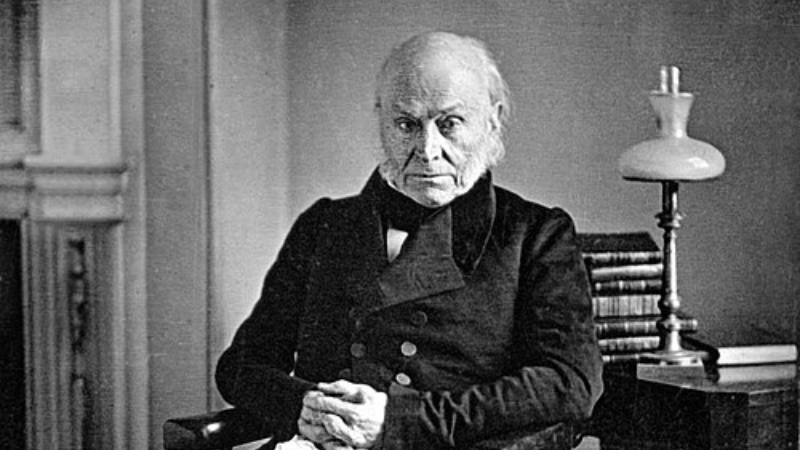
John Quincy Adams and the Catechism of Man-Made Law
On the thirtieth of April, 1839, John Quincy Adams stood before the New York Historical Society to mark the fiftieth anniversary of George Washington’s inauguration. He was seventy-one years old, a former president, and at that moment a sitting congressman from Massachusetts. He called his address The Jubilee of the Constitution. He spoke for the better part of two hours, tracing the descent of the Union from the Declaration of Independence through the failure of the Articles of Confederation to the ratification of the Constitution, and he closed with a peroration that I would ask every Christian reader to consider carefully:
Fellow-citizens, the ark of your covenant is the Declaration of Independence. Your Mount Ebal, is the confederacy of separate state sovereignties, and your Mount Gerizim is the Constitution of the United States. In that scene of tremendous and awful solemnity, narrated in the Holy Scriptures, there is not a curse pronounced against the people, upon Mount Ebal, not a blessing promised them upon Mount Gerizim, which your posterity may not suffer or enjoy, from your and their adherence to, or departure from, the principles of the Declaration of Independence, practically interwoven in the Constitution of the United States. Lay up these principles, then, in your hearts, and in your souls — bind them for signs upon your hands, that they may be as frontlets between your eyes — teach them to your children, speaking of them when sitting in your houses, when walking by the way, when lying down and when rising up — write them upon the doorplates of your houses, and upon your gates — cling to them as to the issues of life — adhere to them as to the cords of your eternal salvation. So may your children’s children at the next return of this day of jubilee, after a full century of experience under your national Constitution, celebrate it again in the full enjoyment of all the blessings recognized by you in the commemoration of this day, and of all the blessings promised to the children of Israel upon Mount Gerizim, as the reward of obedience to the law of God.
I alluded to this passage briefly in a recent episode of The Lancaster Patriot Podcast, in connection with Doug Wilson’s professed love for the constitutional framework. But the passage deserves more than a passing mention, because what Adams does here is more deliberate, more precise, and more revealing than a stray patriotic flourish.
He Is Not Alluding. He Is Quoting.
Set Adams’s imperatives beside Deuteronomy 11.
Moses writes: “Therefore shall ye lay up these my words in your heart and in your soul, and bind them for a sign upon your hand, that they may be as frontlets between your eyes. And ye shall teach them your children, speaking of them when thou sittest in thine house, and when thou walkest by the way, when thou liest down, and when thou risest up. And thou shalt write them upon the door posts of thine house, and upon thy gates” (Deut. 11:18–20).
Adams writes: “Lay up these principles, then, in your hearts, and in your souls — bind them for signs upon your hands, that they may be as frontlets between your eyes — teach them to your children, speaking of them when sitting in your houses, when walking by the way, when lying down and when rising up — write them upon the doorplates of your houses, and upon your gates.”
This is not a general biblical cadence. It is a transcription. Adams follows the Hebrew text clause by clause, in order, altering scarcely a word — except one. Where Moses says these my words, Adams says these principles. Where God claims the human heart for His own law, Adams installs the Declaration of Independence and the Constitution.
Nor does the correspondence end there. Eight verses after the command to bind His words upon the hand, the Lord says: “Behold, I set before you this day a blessing and a curse… thou shalt put the blessing upon mount Gerizim, and the curse upon mount Ebal” (Deut. 11:26, 29). Adams’s Ebal and Gerizim come from the same chapter as his frontlets and doorposts.
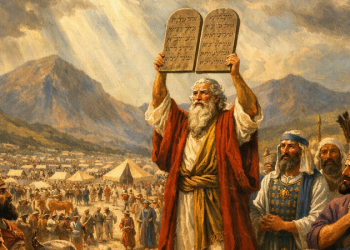
The altar of whole stones on Ebal, the copy of the law of Moses written upon them, the six tribes over against Gerizim and six over against Ebal, the ark borne between them, the reading of all the words of the law, the blessings and the cursings. Adams recounts the scene at Shechem, and then, without pause, tells his hearers that this is their scene, that the ark of their covenant is a document signed in Philadelphia, and that the law written on the stones is the American charter.
The Title Was Not an Accident Either
The address is called The Jubilee of the Constitution. The jubilee is not a general term for an anniversary; it is the fiftieth year of Leviticus 25, the year of release, when debts were forgiven, slaves freed, and every man returned to his possession. Adams is fifty years out from the inauguration, and he reaches for the Levitical number. Within the discourse he calls the day “this festive day of jubilee,” and in the closing charge he anticipates “the next return of this day of jubilee.” The frame is deliberate and sustained from the title page to the final sentence.
In fact, Adams opens by imagining that on the eve of the inauguration, Washington’s guardian angel appeared to him and delivered “a suit of celestial armor” — a helmet of piety and justice, a spear studded with the self-evident truths of the Declaration, and finally “the Constitution of the United States, a SHIELD embossed by heavenly hands, with the future history of his country.” On that shield, he says, was “sculptured (by forms unseen, and in characters then invisible to mortal eye,) the predestined and prophetic history of the one confederated people.”
The Word He Chose for Dissent
There is a further detail that we ought not to miss. When Adams describes the departure of the Articles of Confederation from the Declaration’s principles, he does not call it a mistake, or an error, or bad political theory. He writes that the confederation’s “incurable disease was an apostasy from the principles of the Declaration of Independence.”
Apostasy. The word means a falling away from the faith. Adams reaches for it because, in the theology of his discourse, the Declaration occupies the place where the faith belongs. Departure from it is not merely unwise; it is defection. He goes on to say that the doctrine of unlimited state sovereignty “is not there. The Declaration says it is not in me. The Constitution says it is not in me” — a construction lifted from Job, where the deep and the sea are made to speak concerning where wisdom is not found. The founding documents are personified and interrogated as one interrogates the oracles of God.
This Was Not Secularism
John Quincy Adams was not an unbeliever, and The Jubilee of the Constitution is not a secular document. God is everywhere in it. Adams appeals to “the laws of nature and of nature’s God,” to “a superintending Providence,” to “the Supreme Ruler of the universe,” to “the retributive justice of Heaven.” He remarks that the constitutional oath added “the homage of religious faith… to all the obligations of temporal law, to give it strength.” He closes the whole address with the words, “and Providence our guide.”
The problem is not that Adams removed God. The problem is the office he assigned Him.
In Adams’s construction, God is the witness, the guarantor, and the avenger of a covenant whose terms were drafted by men. The Almighty is invoked to underwrite the document; He is not permitted to write it. Note the direction of the oath: religious faith is “superadded” to temporal law “to give it strength.” Religion is a buttress, and the state is the building. And note the final clause of the entire discourse — the last thing his audience heard — in which Adams promises to their children’s children “all the blessings promised to the children of Israel upon Mount Gerizim, as the reward of obedience to the law of God.” The equation is complete. Adherence to the principles of the Declaration, interwoven in the Constitution, stands in the place occupied at Shechem by obedience to the law of God. The blessings are the same blessings. The obedience is to a different law.
A defender will say that this was oratory, and that a commemorative address before a historical society ought not to be read as a systematic theology. The objection would carry more weight if the biblical apparatus were incidental. But Adams did not merely garnish his speech; he built its title, its opening image, and its closing exhortation on a single covenantal structure. And he told his hearers, in his own analysis, exactly why the exercise was necessary. The Constitution, he explains, is democratic, and a democratic government’s “stability and duration must depend upon the stability and duration of the virtue by which it is sustained” — that virtue being nothing other than “the concretion of those abstract principles which had been first proclaimed in the Declaration of Independence.” The republic endures, on Adams’s own reckoning, only so long as its principles endure “in the hearts and minds of the people.”
The Deuteronomy 11 language, then, is not decoration. It is the mechanism. Adams needed a people who would bind these principles on their hands, and teach them to their children when they sat in the house and walked by the way. He needed a catechism. He knew that a nation is held together by what it loves and rehearses, and he set about producing the affection he required. He says as much elsewhere in the address: the bond of union “is after all, not in the right, but in the heart.”
What He Saw, and What He Missed
There is an irony in the discourse that Adams himself supplies. Having presented the Constitution as a shield embossed by heavenly hands, he later concedes that “the exact limits of legislative, judicial, and executive power, have never been defined,” that these powers “melt so imperceptibly into each other that no human eye can discern the exact boundary line between them,” and that officeholders have repeatedly “mistaken themselves for the power that makes the laws.” He notes, drily, that federal appropriations had risen from $639,000 in 1789 to more than thirty-six million by 1839, and suggests that an inversion of the microscope might not flatter the present day. He records that the Louisiana Purchase was accomplished “by a flagrant violation of the Constitution,” sanctioned afterward by popular acquiescence.
A divine shield whose edges no eye can discern. A perfect frame of government whose officers routinely mistake their offices. A charter violated flagrantly within fifteen years and forgiven by consensus. Adams saw all of it, wrote all of it down, and still told the American people to cling to the thing as to the cords of their eternal salvation.
I raise it because Adams understood something that most Christians in our day have forgotten, and got it exactly wrong in the one place where it mattered.
He understood that a people must stand under a covenant. He understood that a covenant requires a law, and that the law must be publicly proclaimed, bound on the hand, written on the gates, and taught to children when they rise and when they lie down. He understood that a nation lives beneath blessings and curses, and that its posterity will suffer or enjoy them according to its adherence or departure. He understood that no polity survives on procedure alone — that it must be loved, and that the love must be catechized into the young. He understood, in short, that a nation is a covenanted people under a law it did not write.
And then he handed them the wrong law.
I am not saying that Adams built a sound constitutional structure and merely filled it with poor content, as though the framework of separated powers and a standing legislature were a neutral vessel awaiting better cargo. God did not give His people a body of statutes and leave the machinery to their ingenuity. He gave a law and the structure by which that law is administered: an accuser bringing his charge, judges hearing the case, and the revealed law of God applied to the particulars before them. No legislature. No manufacture of new crimes. The magistrate judges; he does not legislate. That structure is not a container for God’s law — it is part of it.
So Adams erred twice, and the second error was the graver. He substituted man’s law for God’s, and he lodged it inside a structure of man’s devising that exists precisely to keep producing more of it. What he grasped was something narrower and, in its way, more penetrating than either: that a people is constituted by the law it binds upon its heart, and that such a law is taught, rehearsed, and loved, or it is not held at all. He was right about that. He was right that a nation must be catechized. He simply catechized them in the wrong book.
Two centuries later, most American Christians have neither the right law nor the right structure — and, having lost both, would not think to speak of a covenant, of national blessings and curses, or of a law to be bound upon our hands and written upon our gates. When we reach for that language at all, we reach, as Adams did, for man-made law and frameworks.
The psalmist did not write, Oh how I love thy Constitution. He wrote, “Oh how love I thy law! it is my meditation all the day.” And he added, “I will speak of thy testimonies also before kings, and will not be ashamed.”
The ark of our covenant is not the Declaration of Independence. The law written on the stones was never ours to replace.