
Have I Misconstrued Doug Wilson’s Love for the Constitution?
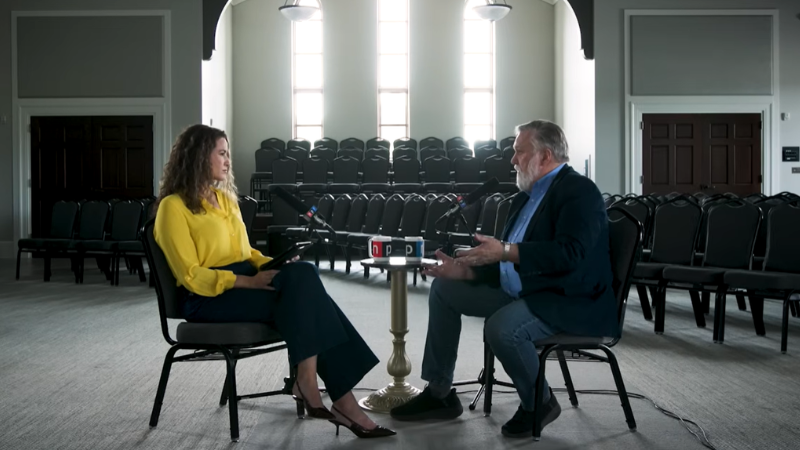
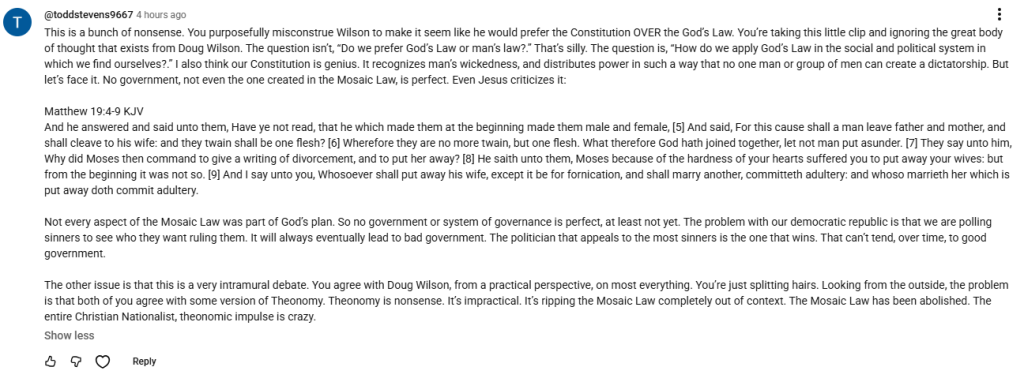
Following my recent episode of The Lancaster Patriot Podcast on Doug Wilson’s remarks to NPR about the Constitution, a viewer going by @toddstevens9667 left a lengthy and substantive YouTube comment in objection. I want to answer it at length, and publicly. It is an efficient anthology of some of the common objections we hear — the charge of misrepresentation, the charge of hairsplitting, the appeal to Matthew 19, the assertion that the Mosaic law has been abolished, and the closing verdict that the whole theonomic project is crazy.
I will take the objections in order.
1. The Charge of Misrepresentation
The comment opens by saying I “purposefully misconstrue Wilson to make it seem like he would prefer the Constitution over God’s Law,” and that I have taken “this little clip” while “ignoring the great body of thought that exists from Doug Wilson.”
Two responses.
First, on the clip. In addition to the soundbites, I played the sixty-second segment in full, precisely so listeners could hear the context, and I said so on air before playing it. I then played a second clip — Wilson’s own statement that he is “not interested in applying Old Testament law straight across with no variations,” and that the judicial laws of Israel have ceased and pertain today only in their general equity. I played the second clip because the two statements belong together, and the argument of the episode was that they are causally related. I also said, more than once, that I have appreciated much of Wilson’s work, that I intended no disrespect to him personally, and that I did not doubt his sincerity. Whatever else that is, it is not the method of a man building a strawman.
Second, on the “great body of thought.” This is an argument that cannot be answered because it has not been made. Wilson said what he said. If somewhere in his corpus he has repudiated the constitutional framework, denied that man possesses legislative authority, and affirmed that God’s revealed law is the sufficient civil standard requiring no supplementation, then the passage should be produced. Until it is, an appeal to unspecified other writings is not a rebuttal; it is a request that a man not be held to his own words.
But note carefully what I did not argue. I never claimed that Wilson consciously ranks the Constitution above Scripture. I argued something more precise and, I think, more troubling for its subtlety: that having concluded God’s judicial law no longer binds, he is left with a vacuum where the civil standard ought to be — and that a vacuum will be filled. The affection follows the vacancy. That is a claim about entailment, not about a man’s heart, and the way to refute it is to show that the entailment does not hold.
2. “The Question Isn’t God’s Law or Man’s Law. That’s Silly.”
Here is the center of the comment, and it is worth quoting in full: “The question isn’t, ‘Do we prefer God’s Law or man’s law?’ That’s silly. The question is, ‘How do we apply God’s Law in the social and political system in which we find ourselves?'”
I would only observe that by the end of his own paragraph, @toddstevens9667 has answered the question he called silly.
He tells us that the Constitution is genius. He tells us that “not every aspect of the Mosaic Law was part of God’s plan.” He tells us that “the Mosaic Law has been abolished.” He has, in other words, made a determination about which law governs and which does not. He has preferred. What he objects to is not that the question was asked but that it was asked out loud, where the answer becomes visible.
And there is a deeper difficulty. He proposes that the real question is “how do we apply God’s Law” to our political system. Very well — but he also holds that the Mosaic law is abolished. So I would put a plain question to him, and I do not think it is a rhetorical trick: which law does he propose to apply? He cannot appeal to a standard he has just declared void. If the judicial law of God is abolished as a rule for civil justice, then the phrase “applying God’s Law” to politics has no content. It is a pious noise. He must either name the divine civil standard he intends to apply, or concede that in the civil sphere the law being applied is man’s — which was precisely the point of the episode he is objecting to.
3. By What Standard Is the Constitution “Genius”?
He writes: “I also think our Constitution is genius. It recognizes man’s wickedness, and distributes power in such a way that no one man or group of men can create a dictatorship.”
Set aside for a moment whether that description is historically accurate. Attend instead to the word wickedness.
Wickedness is not a category the Constitution supplies. The document nowhere defines it and could not. To praise a legal framework for correctly reckoning with human wickedness is to measure that framework against a standard of good and evil that stands outside and above it — which is to say, against the law of God. The compliment he pays the Constitution is a compliment he can only pay by borrowing from the law he says has been abolished. He is standing on the very ground he is trying to remove.
There is a second and more serious problem, and it is internal to his own paragraph. He praises the Constitution because it “recognizes man’s wickedness” and restrains it. A few sentences later he writes: “The problem with our democratic republic is that we are polling sinners to see who they want ruling them. It will always eventually lead to bad government. The politician that appeals to the most sinners is the one that wins. That can’t tend, over time, to good government.”
I ask the reader to hold those two claims side by side. The system is genius because it accounts for human sinfulness. The system will always eventually produce bad government because of human sinfulness. Both cannot be true. He has praised a machine for solving a problem and then explained, in his next breath, that the machine cannot solve it.
Nor will the separation of powers bear the weight he places on it. He commends the Constitution for distributing power so that no one man or group of men can seize total control. But observe what the framework distributes: it distributes, among three branches and fifty states, the authority to make law — to define crimes, invent penalties, and bind consciences. That is an authority God never delegated to any man. The Constitution’s genius is that it prevents one man from doing what Scripture forbids every man to do. Dividing an usurped power among many hands does not restore it to its rightful owner. It only makes the usurpation harder to see, and gives it three branches to grow on.
4. Matthew 19 and the Alleged Imperfection of the Law
Next @toddstevens9667 claims that Jesus criticized the Mosaic law, cites Matthew 19:4–9, and concludes: “Not every aspect of the Mosaic Law was part of God’s plan. So no government or system of governance is perfect.”
The argument rests on a reading of Deuteronomy 24:1–4 that the text will not sustain.
Begin with what the Pharisees say and what Jesus says. In Matthew’s account the Pharisees ask, “Why did Moses then command to give a writing of divorcement, and to put her away?” Jesus answers, “Moses because of the hardness of your hearts suffered you to put away your wives.” The Pharisees said command. Jesus said permitted. Whatever else is happening in this exchange, Jesus is not agreeing with the Pharisees’ description of the law. He is correcting it.
Now go to the statute itself. Deuteronomy 24:1–4 is, in the Hebrew, a single conditional sentence. Verses 1 through 3 form the protasis — the extended “if” clause that describes a situation: if a man marries a woman, and she finds no favor in his eyes, and he writes her a certificate and sends her away, and she goes and becomes another man’s wife, and the second husband dies or divorces her. The apodosis — the actual command, the only imperative in the passage — arrives in verse 4: her first husband may not take her again to be his wife.
Read the passage this way and its whole character changes. Moses does not institute divorce. Moses does not command divorce. Moses does not commend divorce. The statute presupposes that hard-hearted men are already putting away their wives, and it does two things: it requires that a woman so treated be given a legal certificate rather than be left in ruinous limbo, and it forbids her first husband from reclaiming her after she has remarried. The certificate is not a license for the man. It is a protection for the woman. The law is hard upon the hard-hearted and merciful to his victim. That is not a defect in God’s law. That is God’s law doing what civil law does — restraining evil in a fallen world and defending the party who cannot defend herself.
So Jesus is not criticizing the Mosaic law. He is refusing the Pharisees’ abuse of it. They had taken a provision that limited an existing evil and were brandishing it as divine authorization for that evil. Jesus takes them back to creation to show them what marriage is, and He tells them why the concession existed — not because God approved of what they were doing, but because their hearts were hard.
From this @toddstevens9667 draws the conclusion that “not every aspect of the Mosaic Law was part of God’s plan.” I want to say plainly that this claim cannot be squared with Scripture’s own testimony concerning the law. “The law of the LORD is perfect” (Ps. 19:7). “The law is holy, and the commandment holy, and just, and good” (Rom. 7:12). Nehemiah, recounting Sinai, says God gave Israel “right judgments, and true laws, good statutes and commandments” (Neh. 9:13). Moses himself asks, “what nation is there so great, that hath statutes and judgments so righteous as all this law?” (Deut. 4:8). And Christ says, “Think not that I am come to destroy the law, or the prophets: I am not come to destroy, but to fulfil” (Matt. 5:17).
The premise that a divine accommodation to human sin is therefore not part of God’s plan proves catastrophically more than its author intends. Consider what else it swallows. The civil sword of Romans 13 exists only because men murder and steal. The entire sacrificial system existed only because men sin. By this reasoning, none of it was part of God’s plan — and virtually everything God has revealed since Genesis 3 stands under the same indictment. That God legislates for men as they are, rather than as they were before the fall, is not evidence of a flaw in His legislation. It is evidence that He is a wise lawgiver.
There is a final irony. In the very passage cited against the law’s perfection, Christ Himself preserves an exception: “except it be for fornication.” If a permission granted in view of human sin renders a law less than God’s plan, then the objector must apply his own rule to the words of the Lord Jesus. I do not think he wishes to do that. Neither do I.
5. “The Mosaic Law Has Been Abolished”
The comment asserts this flatly, and then adds that theonomy is “ripping the Mosaic Law completely out of context.”
Which law? The Reformers distinguished the ceremonial, the judicial, and the moral. The ceremonial shadows were fulfilled; the book of Hebrews is our warrant there. The Westminster Confession says the judicial laws “expired together with the state of that people, not obliging any other now, further than the general equity thereof may require” (XIX.4) — which is, of course, the very clause Doug Wilson quoted to NPR. But note that even the Confession does not say abolished. It says the judicial law does not oblige further than the general equity thereof may require, which is a statement about the mode of its continuing obligation, not a repeal.
Our critic has therefore gone further than the Confession, and has landed in a position where the civil law of God has simply ceased to speak. And having removed it, he owes us an account of Romans 13. The magistrate is God’s minister, “a revenger to execute wrath upon him that doeth evil.” Evil defined by whom? If God’s revealed civil standard is abolished, then either the magistrate defines evil — in which case the state is the moral authority, and we are precisely where the podcast said we were — or evil is defined by a standard which God has revealed. There is no third thing.
As for context: the context of Israel’s civil statutes is given us in Deuteronomy 4. Moses tells Israel that if they keep these judgments, the surrounding nations will hear them and say, “Surely this great nation is a wise and understanding people.” He then asks what nation has statutes so righteous. That is not a text which treats God’s civil law as a parochial artifact, unintelligible outside the borders of one Bronze Age polity. It is a text which holds it up before the nations as a standard of justice worth envying and imitating.
6. “You’re Just Splitting Hairs”
Two sentences of the comment sit uneasily together. The first: “this is a very intramural debate. You agree with Doug Wilson, from a practical perspective, on most everything. You’re just splitting hairs.” The second: “Theonomy is nonsense. It’s impractical… The entire Christian Nationalist, theonomic impulse is crazy.”
On the substance: it is not hairsplitting. The question dividing us from Wilson is whether man possesses legislative authority — whether the civil magistrate is a judge who applies a law he did not write, or a legislator who manufactures law and then enforces it. Everything downstream depends on the answer: what a crime is, who defines it, what the courts are for, and whether the sword can lawfully fall on a man who has not violated God’s Law.
I would add, since he lumps us in with the Christian nationalists, that the episode he is objecting to was in substantial part a criticism of the Christian nationalist program. We do not want a Christian legislature. We do not want a baptized congress writing better statutes. We want no legislature at all, because God has already legislated.
7. What He Saw Without Seeing It
I close where he closes, because his final diagnosis is spot on.
“The problem with our democratic republic,” he writes, “is that we are polling sinners to see who they want ruling them. It will always eventually lead to bad government. The politician that appeals to the most sinners is the one that wins. That can’t tend, over time, to good government.”
This is exactly right. It is well put, and I would not change a word of it. But I would ask him to follow it one step further. If the fatal defect of our system is that fallen men are polled to determine what shall be lawful, then the remedy is not a better poll, a better electorate, or a better distribution of the polling. The remedy is a law that is not up for a vote. The remedy is a standard of justice that no majority may amend, that no congress may repeal, and that no election may overturn, because it was not given by men in the first place.
He has described the disease with precision and then pronounced the cure insane.
The question, then, is not silly, and it will not go away by being called silly. Every society on earth is governed by a law, and that law comes from somewhere. It is handed down or it is made up. It is God’s or it is man’s. To insist on this is not to indulge in a false dilemma; it is to refuse a false neutrality that has never existed anywhere, in any nation, at any time.