

Where Matt Doyle Misses the Point on Legislation
Matt Doyle has engaged our work on Lancastrian theonomy more consistently than almost anyone online. That is why a recent episode of The Lancaster Patriot Podcast was dedicated to him. We are grateful for a critic who reads closely enough to push back.
But his recent responses share a common flaw. Doyle fails to adequately distinguish between legislation and adjudication, and he misunderstands what a custom is.
This article restates that distinction, applies it to 1 Samuel 30, and shows why the conclusion Doyle draws cannot follow from what was actually said.
The objection, in his own words
Fairness requires stating an argument before answering it. Here is Doyle’s response in full, made to the latest episode of The Lancaster Patriot Podcast:
You [Chris Hume] spent some time in your podcast arguing that 1 Samuel 30:25 was not a new law enacted by David but a “custom” for only him and his band of men. That because he wasn’t king at the time, he was not legislating law. But you went on to say that if that “custom” were universalized and made applicable to all, it would not be a new law but would be a violation of the Eighth Commandment and would be subject to due process and punishment. In other words, 1 Samuel 30:25 was not a new law, but was rather a general equity application of the Eighth Commandment by David. Congratulations and welcome to the world of historic theonomy.
Reduced to its steps, the argument runs this way:
- Hume (that’s me) said that if the custom were universalized, violating it would be theft under the eighth commandment.
- A rule that applies to all, whose violation is punished under the eighth commandment, is a general equity application of God’s law.
- Therefore David’s ruling was a general equity application of the eighth commandment, which is what historic theonomists have always said legislation is.
The argument fails at step 1. It attributes to the episode a claim I never made, and the claim I did make points in the opposite direction.
The distinction Doyle passed over
Legislation is the act of making a new rule that binds everyone going forward. Adjudication is the act of judging a particular past dispute by a rule that already exists. The episode set the two side by side.
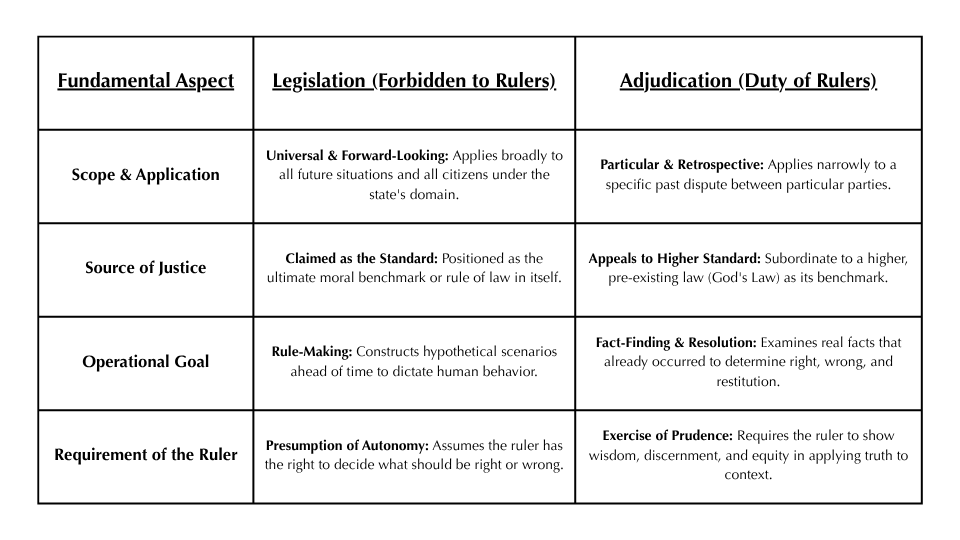
The question in every case is simple: is the ruler applying a law God already gave to a dispute in front of him, or is he imposing a new obligation on everyone? The first is a judge’s duty (Deut. 16:18–20). The second is a prerogative God reserves to himself (Deut. 4:2; 12:32; Isa. 33:22; James 4:12).
Doyle’s response never engages this question. It moves directly from “violating it would be theft” to “therefore it is a general equity law,” as though nothing lay between them. A lot lies between them.
What actually happened at Ziklag
The text settles more than Doyle allows.
1. David held no civil office. Saul was king. David was a fugitive living at Ziklag under a Philistine lord, commanding a band of men who had followed him by their own choice (1 Sam. 22:2; 27:6). Whatever he did at the brook Besor, he did not do from a throne.
2. The ruling arose from a live dispute. After the Amalekites were defeated, “all the wicked and worthless fellows among the men who had gone with David” refused to share the recovered spoil with the 200 men who had stayed by the baggage (1 Sam. 30:22). David answered that dispute: “as his share is who goes down into the battle, so shall his share be who stays by the baggage. They shall share alike” (v. 24). That is a judge deciding a controversy between particular parties. It is adjudication in its plainest form.
3. The word fits custom, not statute. The Hebrew mishpat in verse 25 has a wide range. Three chapters earlier, the same word describes David’s own practice: “Such was his custom all the while he lived in the country of the Philistines” (1 Sam. 27:11). In 1 Samuel 8:9 and 11 it names “the ways of the king.” A practice adopted by David’s company and followed thereafter in Israel is well within the word’s ordinary meaning.
4. The episode’s point about violation was narrow. In the episode, I compared David’s ruling to a company policy. A CEO decides that bonuses will be split between the sales staff and the warehouse staff. If a sales manager later pockets the warehouse staff’s share, he has not broken a new law invented by the CEO. He has committed theft, because that share belonged to the warehouse staff under the terms of the company they had voluntarily joined. The policy is evidence of who owns what. The law broken is God’s.
I then said that such a custom might spread until every company had adopted it, and that this would be fine, because each company had chosen to embrace it. Nothing in the episode said that a custom imposed on everyone by a ruler becomes an application of the eighth commandment. The point was the reverse: voluntary adoption is what keeps a custom from becoming legislation.
The two-company test
The quickest way to see the error is to put two companies side by side.
- Company A has adopted the bonus custom. Its sales manager pockets the warehouse staff’s share. He has committed theft. A judge hears the case, establishes the facts by two or three witnesses (Deut. 19:15), consults the company’s policy as evidence of ownership, and orders restitution under God’s law (Ex. 22:7–9).
- Company B never adopted the custom. It divides its bonuses some other way. Under God’s law, Company B has done nothing wrong. Nobody’s property has been taken, because the warehouse staff never had a claim to that share in the first place.
Now universalize the custom by statute, as Doyle’s argument requires. Company A’s position is unchanged: its manager was already a thief under the eighth commandment, and the statute adds nothing a judge did not already have. Company B, however, has become a lawbreaker. It now owes money it never promised, and it faces punishment for withholding what never belonged to anyone else.
That is the decisive point. Theft presupposes ownership. You cannot steal what is not another man’s. The eighth commandment protects property that already belongs to your neighbor; it does not create new property claims and then punish people for failing to honor them. A statute that requires every company to divide its bonuses a certain way does not apply “You shall not steal.” It manufactures an obligation God never imposed, and then calls the failure to meet it a crime.
The same is true of a modern example. An employer who promised time and a half for overtime and then refuses to pay it is defrauding his worker of wages (Lev. 19:13; James 5:4). An employer who never promised it has stolen nothing. A law requiring every employer to pay it is not the eighth commandment applied. It is a new, man-made commandment, and it is not authorized under theonomy.
So the dilemma for Doyle is this:
- If the universalized rule only punishes those who actually took what belonged to another, it adds nothing to God’s law. A judge can already handle every such case by adjudication. In that case it is not legislation, and there is nothing to concede.
- If the universalized rule punishes those who never agreed to the custom, it is not an application of the eighth commandment. It is a new man-made law, which is exactly what we say the magistrate may not make.
Either way, Doyle’s argument fails.
Application or addition? The parapet and the pool
In another comment, Doyle pressed the point with examples: “Is the application of the Parapet Law in requiring a fence around a swimming pool ‘new law’ or merely an application of that law? Are stop signs and speed limits ‘new law,’ or an application of that law under the Sixth Commandment?“
These examples deserve a careful answer, because the parapet law turns out to be one of the clearest demonstrations of our position.
1. Read what the parapet law actually commands. “When you build a new house, you shall make a parapet for your roof, that you may not bring the guilt of blood upon your house, if anyone should fall from it” (Deut. 22:8). There is no inspector, no permit, no fine for a roof without a parapet. The only sanction in view is bloodguilt if anyone should fall. The law binds the conscience of every builder, but the magistrate enters only after a man has been harmed.
2. Then compare the “application.” A statute that fines every pool owner whose pool lacks a regulation fence, before any child has been harmed, does something the parapet law never did. It attaches a civil penalty to the mere failure to build, where God attached none. The “application” is stricter than the law it claims to apply. That is not general equity. That is adding to God’s law, which is exactly what Deuteronomy 4:2 forbids. The genuine application is the one a judge makes after harm has occurred. If a neighbor’s child drowns, the judge must inquire diligently: Was the owner careless? Did he know of a danger and disregard it? Did the child’s own guardians bear responsibility? No two cases are alike, and the answer requires wisdom, not a checklist. Where the owner’s carelessness is proven, he bears the guilt. Where it is not, he does not.
3. God’s law protects through judgment, not prior restraint. Doyle also argues that these laws are meant to protect people, not merely to settle cases in court. They do protect. But they protect the way Deuteronomy says they do: “the rest shall hear and fear, and shall never again commit any such evil among you” (Deut. 19:20). It deters by the certainty of just judgment after the fact. A builder puts up a parapet because he knows he will answer for blood if he doesn’t. Protection through liability is adjudication at work. Protection through punishing men who have harmed no one is something God’s law never authorizes.
4. Speed limits follow the same pattern. The sixth commandment forbids murder, and the case laws reach the man who injures his neighbor in a fight or through carelessness (Ex. 21:18–19, 22–25). A judge can and should deal with a reckless driver who harms or kills. But a fine for driving 80 in a 55 on an empty road punishes a man for a harm that never occurred. It is not the sixth commandment applied. It is a new crime with a new penalty.
General equity rightly understood
Doyle’s response seems to assume that affirming general equity is a concession on our part. It isn’t. Lancastrian theonomy has always affirmed it. In Redeemed by Justice, we say so in plain terms: “The general equity of these laws is applied in adjudication between disputants, not in creating new laws.”
The Westminster Confession speaks of the judicial laws as binding “further than the general equity thereof may require” (WCF 19.4). The question that phrase leaves open is not whether God’s law reaches cases Moses never named. Of course it does. The goring ox teaches a principle of negligence that reaches the owner of a dangerous dog or a reckless driver (Ex. 21:28–29). The open question is who applies that equity and how:
- A judge, case by case, examining the facts of a particular dispute and applying God’s law to them, as Moses commanded (Deut. 1:16–17; 16:18–20).
- Or a legislature, by blanket statute, writing a rule in advance that binds every person whether or not any neighbor has been wronged.
The first is general equity adjudication. The second is legislation that borrows the language of general equity. Every man-made law can be described as “an application of the eighth commandment” by someone. The tax code, licensing schemes, and wage regulations are all defended in exactly those terms. If “it applies a commandment” is enough to make a statute legitimate, then there is no statute the principle cannot justify, and “general equity” has stopped limiting the magistrate at all.
A side note on Bahnsen and the kings
In the episode Doyle was responding to, I noted that Bahnsen observed that Israel’s kings “do not seem to have had legislative power, but they were essentially judges or governors” (Theonomy in Christian Ethics, p. 390). In the episode, I could have stated the point more carefully. The claim that matters is not that no king ever tried to make law. It is that no king was authorized to. Deuteronomy 17 gave the king a copy of the law to read, not a pen to add to it, “that his heart may not be lifted up above his brothers” (Deut. 17:18–20). What wicked kings actually did is a separate question.
But here is something worth pondering. When Ahab wanted Naboth’s vineyard, he did not pass a law seizing it. Jezebel staged a trial instead: two false witnesses, a charge of blasphemy, and a stoning (1 Kings 21:8–13). She corrupted judgment rather than inventing a new law. Even the most notorious tyrant in Israel’s history seems to have assumed that the only lever available was adjudication, and so she perverted it. That fits the pattern the prophets condemned again and again: not rulers who legislated, but judges who took bribes and turned aside the needy in the gate (Amos 5:12).
Doyle is right that Bahnsen never applied his observation the way we do. We’ve never claimed otherwise. But Bahnsen also wrote this: “Outside of those areas where God’s law prescribes their intervention and application of penal redress, civil rulers are not authorized to legislate or use coercion” (“The Theonomic Position,” in God and Politics, 1989, p. 24). Where does God’s law prescribe penal redress against a roof without a parapet from which no one has fallen, or a driver who has harmed no one? Perhaps the better question is not whether we have departed from historic theonomy, but whether the “general equity” statutes have departed from Bahnsen’s own principle.
The Reformation didn’t end with Luther and Calvin, and it didn’t end with Rushdoony and Bahnsen. Each generation builds on the last. This is a question whose time has come.
Conclusion
Doyle’s response treats two different things as one. A custom that each company or each band of men adopts by its own choice is not a law. Violating it is wrong only where a man takes what already belongs to another, and a judge can address that under God’s law without any new statute. A rule that a ruler imposes on everyone, binding even those who never agreed to it, is legislation. It does not apply the eighth commandment. It adds to it.
The distinction is not a technicality. It decides whether Company B is innocent or criminal, whether a farmer may sell milk to his neighbor without a license, and whether the magistrate is a minister of God’s justice or an author of his own. Without a proper understanding of general equity adjudication every statute on the books can be dressed up as “general equity.” But with a proper understanding of God’s Law the magistrate is confined to the gate, judging disputes between a man and his neighbor by the law God has already given.
That is all Lancastrian theonomy has ever claimed, and 1 Samuel 30 does nothing to disturb it. If anything, the scene at the brook Besor shows the biblical pattern at work: a dispute arises, and a leader judges it. A custom may grow from that ruling, but only because others freely choose to adopt it in their own communities.
I remain grateful for Mr. Doyle’s engagement and welcome his reply.