
A Father’s Door Is Not the Magistrate’s Sword
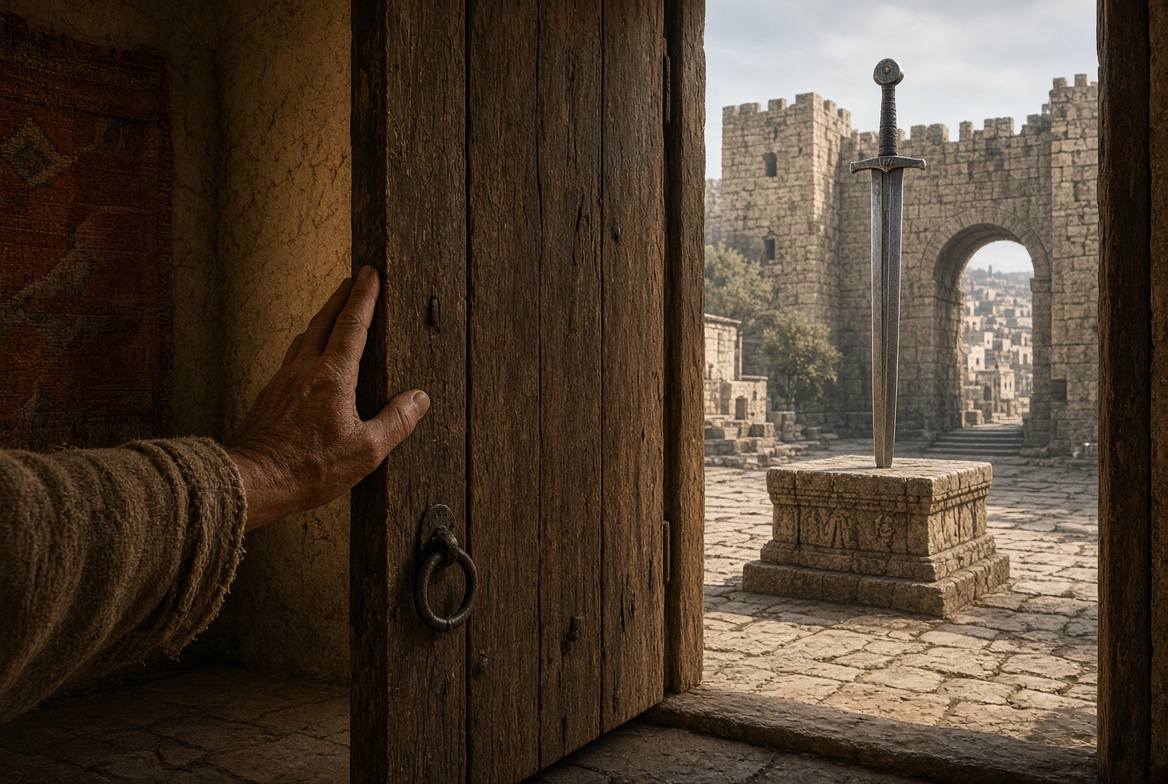
Christian nationalists frequently argue that because a homeowner can keep people out of his house, the civil magistrate must be able to keep people out of the nation. The analogy appears obvious at first glance. A man controls the threshold of his own property; therefore the state should control the threshold of the country. The problem is that the logic does not stop at the front door.
A father is also clearly authorized to feed, clothe, nurture, and educate his children. If the mere fact that a father possesses a certain authority means the magistrate inherits that same authority, then the magistrate should likewise be feeding, clothing, nurturing, and educating the adult population. Most Christian nationalists rightly reject that second claim. They should reject the first one for the same reason. A father’s authority over his household does not transfer to the civil magistrate, whether the issue is immigration or the daily care of grown men and women.
Scripture draws a categorical line between the jurisdiction of the father and the jurisdiction of the magistrate. As we have argued elsewhere, the father is given formative, pedagogical authority. He may establish household rules that go beyond the explicit case law of Scripture because his children are not yet fully responsible adults. Hebrews 12:10 says earthly fathers discipline “as it seemed best to them.” The rod, curfews, and household standards exist to drive foolishness from the heart and prepare the child for dominion. The magistrate receives no such commission. His task is retributive and adjudicative. He is God’s servant to punish those who do evil and to praise those who do good (Romans 13:3–4; 1 Peter 2:14). He sits in the gate and establishes justice between neighbors according to the Law of God (Amos 5:15; Deuteronomy 16:18–20). He does not raise children, form character, or set household rules for adults. The magistrate’s duty is found not by looking at what a father does in the home, but by looking at what Scripture calls him to do: establish justice by punishing evildoers—those who break God’s Law—not “protect” the people by controlling their movement.

This is why the immigration analogy fails. Crossing a border is not evil in itself. Emigration and immigration are not crimes under God’s Law. The magistrate has no biblical warrant to punish the simple movement of people any more than he has warrant to decide what adults may eat, when they may sleep, or how they must educate their children. Treating the nation as an extended household places the magistrate in the role of father and turns the sword of justice into a rod of nurture.
At the same time, no wall or bureaucracy will ever keep every wicked person out. Evil does not respect fences. The practical reality is that some ungodly people will enter any land. The question is not whether we can create a perfect barrier. The question is whether the land itself is hostile to wickedness. The strongest protection against the ungodly is not a concrete wall but a strong immune system—the consistent application of God’s Law. When justice rolls down like waters and the people (with the blessing of the magistrate) actually punish theft, fraud, rape, murder, and open idolatry according to Scripture, the land becomes a high-friction environment for the wicked. They do not want to live where their preferred sins carry real consequences. At the same time, the upright are attracted to a place where they can take dominion in peace. Righteousness repels the one and draws the other.
This is the opposite of the current arrangement. A nation that rejects God’s judicial system, tolerates open idolatry and perversion, and sustains a large class of freeloaders through forced redistribution sends a clear signal: the Law of God is not enforced here. Wicked people notice. They are not primarily drawn by the absence of a wall. They are drawn by the absence of justice. Man-made immigration controls cannot solve a problem that originates in covenant unfaithfulness. They often make it worse by creating new bureaucracies, new opportunities for corruption, and new ways for the righteous to be hindered while the wicked still find a way in.
The call is not to libertarian open borders. It is to biblical justice. The magistrate is not a father. He is not authorized to keep people out of the nation simply because a homeowner can keep people out of his house. He is authorized to punish actual evil once it occurs, according to the standard God has already revealed. When that standard is applied without partiality to native and sojourner alike (Leviticus 24:22), the land itself becomes the barrier. Until then, no amount of border enforcement will substitute for the repentance and obedience the Lord requires.