


Refuting the Fallacy of Tactical Compliance as Moral Compromise
In contemporary theological discussions surrounding civil government and the scope of Christian obedience, a pervasive error continues to muddy the waters: the conflation of coercive power with righteous authority.
This objection is frequently raised against Lancastrian theonomists. We argue that civil magistrates have no God-given authority to create and enforce man-made laws. At the same time, we sometimes comply with those laws under threat of further penalties, and at other times we refuse. Critics treat this as a contradiction. They claim that if you ever comply, you have conceded the magistrate’s authority; if you ever refuse, you are in sin. Both claims are wrong.
When faced with the biblical assertion that civil magistrates lack God-given authority to issue statutory mandates—such as requiring licensure for peaceful commerce or travel—critics frequently attempt a logical “gotcha.” They point to instances where Christians comply with arbitrary regulations (such as obtaining a driver’s license or paying an unjust fine) and declare, “If you comply with the law, you acknowledge the magistrate’s authority; if you advocate disobedience, you are in sin.”
This objection rests on a fundamental misreading of Romans 13, a failure to distinguish between de jure authority and de facto power, and a series of elementary logical fallacies.
The magistrate’s actual God-given task is narrow: to adjudicate real disputes and punish actual crimes (theft, murder, fraud, violence, and the like) according to God’s revealed judicial law. When he does this, he acts within de jure authority. Everything else he does—licensing peaceful work, regulating travel, or imposing positive statutes—falls outside that jurisdiction.
1. The Distinction Between De Jure Authority and De Facto Power
To evaluate the moral weight of any civil command, one must first determine whether the magistrate possesses the jurisdiction from God to issue it.
Scripture establishes that God is the sole supreme Lawgiver (James 4:12; Isaiah 33:22). Civil magistrates do not possess delegated authority to enact new moral laws or build statutory frameworks; their jurisdiction is strictly limited to enforcing God’s pre-existing judicial law—specifically, serving as a “terror to evil conduct” by punishing actual crimes such as theft, murder, fraud, and violence (Romans 13:3–4; Deuteronomy 19:15–21).
When a magistrate acts within this biblical boundary (namely, adjudicating cases), he exercises de jure authority (lawful, God-ordained authority). However, when a civil entity exceeds its biblical jurisdiction—such as requiring a permit to sell bread baked in one’s own kitchen, or requiring permission to travel on public roads—it ceases to act as God’s minister. It acts instead as an unlawful usurper exercising de facto power (naked force).
An arbitrary decree issued without biblical jurisdiction carries zero moral weight in conscience.
2. Exposing the False Equivalence: The Mugger Analogy
The claim that complying with an unbiblical statute constitutes a “compromise of principle” relies on a False Equivalence Fallacy. It equates submitting to superior physical force with validating the moral legitimacy of that force.
Consider a simple paradigm: A mugger approaches a man in an alleyway, produces a weapon, and demands his wallet. The man hands over the wallet to preserve his life.
- Did the man commit a sin by handing over his wallet? No.
- Did he acknowledge the mugger’s moral right to his property? No.
- Did he “compromise” his principles? No.
The moral culpability in this scenario rests 100% on the thief making the unlawful demand, not on the victim managing his safety under duress. The wallet owner would not be in sin if he complied, fled, or violently disarmed the mugger. None of those options acknowledges the mugger’s moral right to the property.
Calling a Christian a “compromiser” for obtaining a driver’s license or paying an unjust municipal fine is logically identical to calling a mugging victim a compromiser for handing over his wallet. Both acts are instances of tactical compliance under duress. Recognizing that a bully possesses the physical power to destroy your livelihood or lock you in a cage is not an admission that God gave him the moral authority to rule you.
3. The Proper Exegesis of Romans 13 and 1 Peter 2
Statutory absolutists often cite Romans 13:1–2 and 1 Peter 2:13–17 as a blank check for government overreach, asserting that Christians must obey every civil law that does not directly command them to sin.
This interpretation suffers from two fatal flaws:
A. Ignoring the Context and Character of the Magistrate
Paul defines the magistrate in Romans 13:3–4 not as an arbitrary tyrant whose every whim is law, but as one who is a “duty-bound minister of God for your good.” The authority granted to the office is covenantal and conditioned upon its function: praising good and punishing evil as defined by God’s standard. Paul does not say the magistrate is to punish whatever he has declared illegal. He says the magistrate is to punish those who do evil and praise those who do good—evil and good as God has already defined them. When a civil ruler inverted these roles—punishing Christians for taking dominion—he acts ultra vires (beyond his legal power) and forfeits his claim to moral obedience.
B. Confusing Moral Duty with Prudent Strategy
Scripture nowhere commands Christians to seek martyrdom over petty statutory overreach, nor does it forbid tactical submission to avoid greater harm. However, this does not mean a Christian could not, with wisdom and prudence, disobey a man-made law (or refuse to pay a fine) for a strategic purpose.
In Acts 16:35–37, when the magistrates of Philippi ordered Paul and Silas to leave prison quietly after illegally beating them, Paul refused to obey them. He demanded that the magistrates come down personally and escort them out to make a public point. Yet on other occasions, Paul submitted quietly, fled cities under cover of night (Acts 9:25), or invoked his Roman citizenship strategically (Acts 22:25).
Was Paul being inconsistent? Absolutely not. He understood that while an illegitimate command carries no moral obligation, tactical wisdom dictates when to yield and when to make a stand.
4. Nullification, Wisdom, and the Path Forward
Choosing whether to resist an unjust fine or comply under duress is an issue of prudence, strategy, and timing—it is not a measure of one’s allegiance to God’s law. Histories of reformation demonstrate that meaningful resistance against state overreach rarely succeeds through isolated, individual heroics. It requires community alignment and collective nullification.
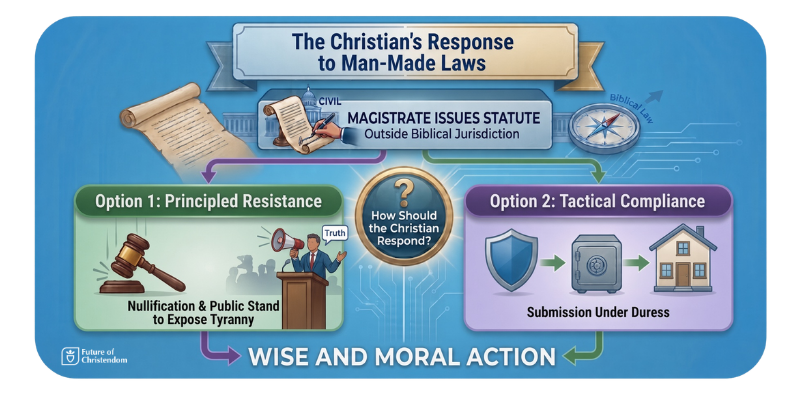
- When an individual pays an unjust fine or obtains an arbitrary license, they are often simply recognizing that they currently lack the local support structure necessary to win that specific battle today.
- Conversely, when Christians rally together to defend a family selling sourdough bread without a state permit, or a man cited for operating an unlicensed home business, or a farmer fined for selling raw milk, they build the groundwork for localized nullification—showing the state that its unbiblical statutes will no longer be tolerated.
At the same time, prolonged and habitual compliance can dull a people’s ability to see the distinction between tactical prudence and moral obligation. The goal is not isolated heroics, but growing local capacity to nullify what God never authorized.
Conclusion
We obey God’s law out of moral obligation. We navigate human statutory regulations out of tactical self-defense. To conflate the two is to abandon both biblical logic and moral clarity. The civil magistrate is not a god; his legislated whims are not law; and a Christian’s decision to render peace under coercion is a demonstration of wisdom, not a compromise of faith.