
The Case for Capital Punishment for the Use of Psychedelic Drugs in a Theonomic Society
When someone enters into the realm of Theonomic ethics, there are often many presuppositions and assumptions that necessarily end up being confronted and challenged. Take, for example, the idea that the Bible prescribes the death penalty for rape. This isn’t particularly controversial in and of itself, but the key text for that conclusion includes that same penalty for adultery. Really? Public execution for adultery? To our modern ears, this seems incredibly harsh. Why, if this law were implemented today, it would be a bloodbath!
But there’s no denying that adultery is severely frowned upon within the pages of Scripture, to the extent that covenant unfaithfulness and idolatry is regularly framed in terms of adultery. And when one digs deeper into the effects that rampant adultery and no-fault divorce has brought upon our nation, we might realize that perhaps there’s some wisdom to it after all.
For adultery does not merely harm the individuals involved; it harms covenant, family, inheritance, and the very stability of future generations. And when divorce is treated as a private lifestyle choice, severed from covenantal duty, the fruits become painfully obvious: fractured households, mass fatherlessness, the economic instability of single-parent homes, generational poverty, psychological and emotional trauma in children, lower educational attainment, depressed birthrates, a decline in marriage and family formation, and the erosion of basic social trust. We have lived long enough under a regime of no-fault divorce to witness its harvest. It has not been liberation, but destruction. All of it born from an assumption that marriage is merely personal, and that adultery is merely unfortunate, rather than covenantal treason against the smallest and most foundational polity God established.
Similarly, some are often surprised to find that God’s law doesn’t prohibit intoxication. While Scripture is abundantly clear regarding the sinfulness of drunkenness, nowhere does it invest the power to regulate it to any civil authority. By what mechanism do we see in Scripture that could outlaw, criminalize, or restrict drunkenness in public or private? None. And an even greater surprise comes when we apply this same line of thinking to recreational drug use. Much the same as drunkenness or alcoholism, there is very little question as to the sinfulness of recreational drugs. We are repeatedly commanded to be sober-minded, watchful, discerning our time, and ready for action when called upon. Alcohol and drugs alike will dull and hamper our sober-minded calling, not to mention the detriment to health and family that substance addiction invariably brings.
Yet while Scripture condemns drunkenness, it does not delegate to the civil magistrate the power to punish it. The mechanisms of accountability lie in other jurisdictions: the family, the church, and the covenant community. Pastors, elders, parents, and peers can exhort, admonish, and rebuke; the church can discipline; and the family can correct and constrain. But the state is not authorized to legislate sobriety or punish mere intoxication any more than it is authorized to punish mere gluttony or wrath.
With this in mind, I find no argument, law, or reasoning that can be rooted in Scripture that would prescribe execution or even punishment for merely using drugs. To be clear, this discussion does not include crimes committed while intoxicated. If someone goes on a drug-induced rampage and murders someone, he is fully liable for that murder. If someone operates a vehicle while drunk and crashes into another vehicle and kills its occupant, his intoxication is irrelevant to the verdict, since manslaughter already demands the death penalty. The argument here is not that substance abuse is harmless, but that Scripture does not grant the state the jurisdiction to punish a sin simply because it is harmful. It punishes crimes, not merely vices.
However, I believe a biblical case can be made for one exception: psychedelic drug use.
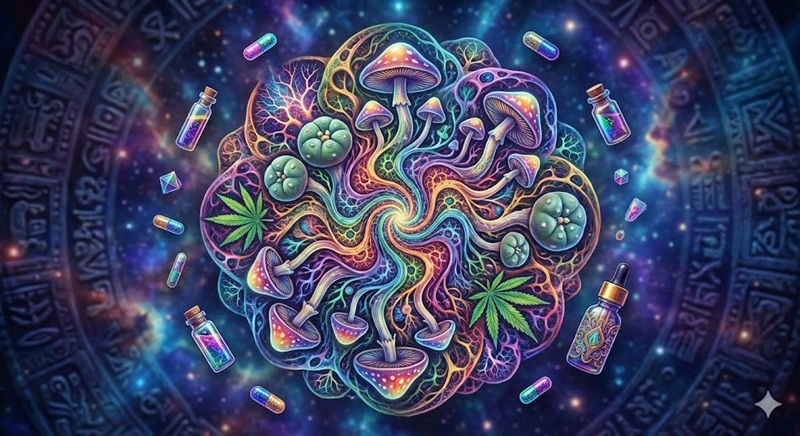
For psychedelics are not ordinarily used to dull the mind, as alcohol does, but to awaken it toward altered states of consciousness historically associated with divination, sorcery, necromancy, shamanism, and pagan worship. In Scripture, such practices were not treated as private vices but as covenantal treachery, as they opened the door to false mediation, false knowledge, and false gods. In other words, psychedelics tend to function not as tools of intoxication, but as sacraments of worship.
In the New Testament, the word pharmakeia is often translated as sorcery or witchcraft. It does not refer to simple medications or the practice of healing. Luke was a physician, and Scripture regularly speaks favorably of ointments and balms for healing purposes. Rather, pharmakeia concerns the use of potions, mixtures, and substances that had a religious function among the pagan nations. It describes drug-assisted contact with the spiritual realm, deeply tied to idolatry and divination. This helps explain why Paul includes pharmakeia in his list of “works of the flesh” in Galatians 5:20, alongside idolatry and enmity, and why Revelation speaks of Babylon “deceiving the nations” by her sorceries (Rev. 18:23). Scripture is not condemning Nyquil, it is warning about substances used as a tool of worship, mediation, and spiritual encounters.
History confirms this usage. Pagan cultures everywhere used psychedelics, intoxicants, or plant mixtures in worship rituals. These substances opened a door to the unseen world and facilitated communion with spirits, ancestors, and gods. The Greek Eleusinian Mysteries used a ritual drink called kykeon, which likely contained ergot and produced vivid visions believed to come from the divine. The Romans likewise knew of opium poppy resin and used it in religious and funerary contexts, both for visions and for contact with the dead. In Egypt, the blue lotus was employed for ceremonial and religious purposes and was depicted in tomb art as a plant associated with rebirth and the afterlife. The ancient Near East also had access to mandrake, referenced in Genesis 30, which was widely regarded as possessing psychoactive and fertility-related properties.
Outside the biblical world, the pattern continues. In Mesoamerica, the Aztecs used mushrooms called the flesh of the gods. In North America, peyote was used for visions and spiritual instruction. In the Andes, the San Pedro cactus held similar significance. In the Amazon, ayahuasca became central to shamanic healing and communion with spirits. Siberian shamans ingested fly agaric mushrooms to enter trance and communicate with the unseen. In West Africa, the Bwiti religion used iboga for initiation and contact with the dead. Throughout Polynesia, kava was part of ceremonial life. The details differ, but the pattern remains the same.
Pagan worship and psychedelics go together.
Once that pattern is seen, the biblical severity toward sorcery becomes clear. The law does not prescribe execution for a man who becomes drunk and collapses on his couch, or smokes a joint and gets a bad case of the munchies. It does not attach penalties to the mere dulling of the senses, though it is still clearly sin. But sorcery, witchcraft, divination, necromancy, and consulting mediums are treated altogether differently. Exodus 22:18 forbids sorcery entirely. Leviticus 20 warns that those who turn to mediums and necromancers are “whoring after them,” invoking covenantal betrayal. Deuteronomy 18 forbids divination, fortune telling, charms, necromancy, and inquiring of the dead, calling these practices “abominations” that justified the dispossession of the Canaanites. The issue is mediation. Idolatry is not a private belief. It is an alternative covenant with alternative revelation and alternative gods. It has sacraments and rituals, priests and prophets. And in the ancient world, psychedelic substances were often the liturgical assistance that made these encounters possible.
What is striking is how modern psychedelic use is being presented in essentially the same terms. It has not entered mainstream culture as mere recreation. It has entered as a spiritual technology. Celebrities and cultural influencers speak of ayahuasca ceremonies and DMT encounters using the language of conversion and initiation. Aaron Rodgers credits ayahuasca with “seeing” love more fully and gaining new direction in his life. Prince Harry describes psychedelic experiences as instruments of interior transformation. Mike Tyson reports what he describes as a death and rebirth of the self after smoking DMT.
Joe Rogan has perhaps been the loudest mainstream voice in this regard. For years he has insisted that DMT and other psychedelics allow one to “peer behind the curtain,” to encounter entities or intelligences that cannot be dismissed as hallucinations. He speaks of these encounters as real in the most existential sense and argues that psychedelics provide access to knowledge or insight unavailable to the ordinary mind. Rogan is not alone. Artists, musicians, actors, and Silicon Valley entrepreneurs have begun describing mushrooms, LSD, and ayahuasca as gateways to creativity, healing, revelation, and meaning.
One of the more interesting modern accounts comes from the book The Return of the Dragon, which collects testimonies from psychedelic users around the world. What stands out is not the diversity of experience, but the remarkable consistency. Whether the user is in South America, Eastern Europe, California, or Southeast Asia, and whether the substance is DMT, mushrooms, ayahuasca, or something else, many report seeing the same kinds of beings. Serpents, dragons, machine elves, mantid-like intelligences, winged figures, and instructors who speak in riddles or dispense secret knowledge. It is striking that these visions appear the same regardless of culture, religion, or expectation. In a purely materialistic model, one would expect hallucinations to be as varied as imagination itself. Yet the reports converge on imagery and entities that Scripture would readily recognize. The serpent, in particular, appears again and again. It is no small thing that the first spiritual antagonist in Genesis takes the form of a serpent, or that Revelation calls Satan “that ancient serpent.” Pagan religions have long associated serpents with forbidden knowledge, immortality, and divine healing. Modern psychedelic users report much the same, without any need to borrow from the Bible or ancient mythology. In other words, the content of these visions is not arbitrary. It is consistent, intelligent, and theological.
What all of this suggests is that psychedelics are not chiefly recreational and they are certainly not neutral. They are not simply another means of intoxication or escape. They are, by design, tools for spiritual experience. And if Scripture is to be taken seriously, these experiences are not mere figments of imagination. Paul reminds us that “we wrestle not against flesh and blood,” but against spiritual forces (Eph. 6:12). The Bible does not present the spiritual realm as unreal or inaccessible. It presents it as real, regulated, and dangerous. Paganism sought communion with gods and spirits that were not the Lord. Our modern world has rediscovered the substances and rites of the ancient world, and it is using them for the same ultimate purpose: to make contact. Yet contact with what? Scripture’s answer is that when contact does not come through the covenant God and His appointed mediation, it is contact with deceiving spirits (1 Tim. 4:1), however enlightening or benevolent they may appear.
That is the distinction between generic intoxicants and psychedelics. Alcohol dulls. Marijuana slows the intellect. Psychedelics seek revelation and enlightenment. Alcohol puts a man to sleep. Psychedelics wake him up to a realm he is not meant to explore. Scripture treats the former as sin because it impairs self-control and sobriety, but it treats the latter as sorcery because it attempts unauthorized spiritual mediation. That is why sorcery belongs to the category of capital crimes in biblical law, while drunkenness does not. One represents covenantal treason through rival worship. The other represents personal sin and folly. And while the modern world insists it is secular and scientific, its psychedelic revival has betrayed a hunger that is unmistakably spiritual.
“You shall not suffer a witch to live” (Exodus 22:18). At first glance, that command may seem shockingly severe to modern readers, but the severity lies not in drunkenness or intoxication, but in sorcery. Scripture does not command the magistrate to punish a man for dulling his senses or making a fool of himself, however sinful that may be. The law does not attach execution to alcohol, nor to gluttony, nor to foolishness, nor even to the many miseries that accompany addiction. But the witch, the sorcerer, the necromancer, and the diviner stand in a different category altogether. They seek revelation, power, and mediation outside of the covenant God. They commit treason against the highest throne.
My contention here is not that all recreational drug use falls under this penalty, nor that every substance a man may use to alter his mind is therefore capital in nature. If that were the case, then Scripture itself would be a witness against the argument. But psychedelics, especially when used for spiritual enlightenment, visionary encounters, or communion with unseen intelligences, match the biblical category of pharmakeia far more closely than mere intoxication. Psychedelics do not simply impair a man. They function less as escapism and more as a liturgy, a sacrament, a counterfeit priesthood.
And this brings the matter home for our present age. The modern psychedelic revival is not emerging as a party fad or a casual amusement. It has returned clothed in spiritual language. Its practitioners speak of healing, revelation, wisdom, enlightenment, transformation, and encounters with entities. They hold ceremonies and retreats. They testify to guidance, instruction, and rebirth. All of this is the vocabulary of worship. It may be arranged in a secular clinic rather than a sacred grove, but the aim is the same: to seek contact with something beyond the veil apart from Christ and apart from His appointed means.
A drunkard or a pot-head sins against himself and those under his care. A psychedelic seeker sins in the direction of worship. The former is folly. The latter is rebellion. Scripture distinguishes between the two, and so should we. The state has neither the jurisdiction nor the mandate to police every vice. It does, however, bear the sword against rival gods and rival covenants. And while the modern world insists it is secular, its fascination with psychedelics betrays a hunger that is unmistakably religious. If man will not seek revelation through the Word of God, he will seek it through visions. If he will not enter the Holy of Holies through Christ our mediator, he will knock at other doors. Scripture names those doors sorcery. Scripture also names the penalty: Death.