
Rules So Righteous (A Series on God’s Law – Part 5)
See, I have taught you statutes and rules, as the LORD my God commanded me, that you should do them in the land that you are entering to take possession of it. Keep them and do them, for that will be your wisdom and your understanding in the sight of the peoples, who, when they hear all these statutes, will say, ‘Surely this great nation is a wise and understanding people.’ For what great nation is there that has a god so near to it as the LORD our God is to us, whenever we call upon him? And what great nation is there, that has statutes and rules so righteous as all this law that I set before you today? (Deuteronomy 4:5-8)
Introduction
Having considered the importance and purpose of God’s law, specifically as it is expressed in the Mosaic Covenant, we come to one of the points of greatest contention among Christians: How we are to apply God’s law to our lives today.
In order to properly deal with any issue of interpretation and application, we must always consider the context of a passage. This is true whether we are talking about biblical narrative, poetry, prophecy, or law. In every case, the underlying principles of interpretation always remain the same. In fact, one way to discern whether or not someone is misapplying the Scriptures is to see if they are consistently using the principles of interpretation. If they use a different set of rules for different passages that are within the same context and genre, you should be skeptical of their conclusions.
While there are many books out there that address the topic of interpretation in great detail, here are a few questions you should ask yourself when reading the Bible in order to best understand the meaning of a passage:
- Who is the original author and who is the original audience?
- What major historical events have taken place, or are taking place, at the time that the passage is written?
- What aspects of that culture and time period are relevant to understanding the passage?
- What is the author intending to communicate to the original audience?
- What words, phrases, or images are being used or repeated by the author and how do they impact the message being communicated?
These questions seek to highlight the main aspects of what are known as the historical-grammatical principles of interpretation. That is a fancy way of saying that, to understand the meaning of a passage, we need to look at the words in their context. That context includes aspects of history, culture, language, geography, and theology. And although this seems overwhelming at first, it is nothing different than what we do on a regular basis when we try to find the truth, or meaning, of anything else that we read or hear.
Covenantal Context
When it comes to understanding God’s law, we can use the above questions to help us get to the meaning, or purpose, of a law. This is the first thing we need to do prior to trying to apply the law to our modern context. The reason for this is simple: God’s law is not given to people in a vacuum.
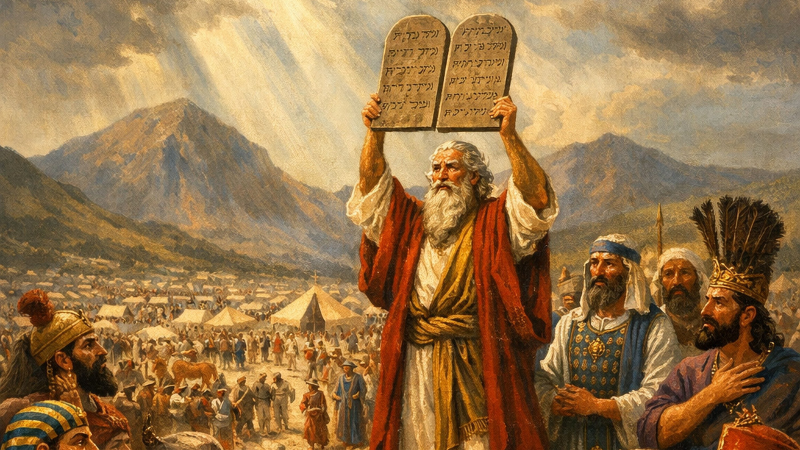
For example, the Ten Commandments were not just a summary of the laws that God gave to the people of Israel through the prophet Moses. They were the official covenant documents between God and the nation of Israel. To use modern terminology, they served as Israel’s constitution.[1]
The passage that best seems to highlight the Mosaic Law as Israel’s covenant/constitutional document is found in Exodus 24:
Moses came and told the people all the words of the LORD and all the rules. And all the people answered with one voice and said, “All the words that the LORD has spoken we will do.” And Moses wrote down all the words of the LORD. He rose early in the morning and built an altar at the foot of the mountain, and twelve pillars, according to the twelve tribes of Israel. And he sent young men of the people of Israel, who offered burnt offerings and sacrificed peace offerings of oxen to the LORD. And Moses took half of the blood and put it in basins, and half of the blood he threw against the altar. Then he took the Book of the Covenant and read it in the hearing of the people. And they said, “All that the LORD has spoken we will do, and we will be obedient.” And Moses took the blood and threw it on the people and said, “Behold the blood of the covenant that the LORD has made with you in accordance with all these words.” (Exodus 24:3-8)
In this scene, we see the public presentation of the law along with its verbal affirmation by the people. Their oath to serve God and adhere to the law is then sealed with the sprinkling of blood upon them by Moses. In this way, the Mosaic Law (summarized in the Ten Commandments) acted as the official constitution that set Israel apart from the nations around them.[2]
Yet not only was the Mosaic Law binding upon the common people of Israel, it was also meant to be the foundation for all law and order in the land. This is seen clearly in Deuteronomy 17, where God gives rules concerning how Israel’s king was to behave:
And when he sits on the throne of his kingdom, he shall write for himself in a book a copy of this law, approved by the Levitical priests. And it shall be with him, and he shall read in it all the days of his life, that he may learn to fear the LORD his God by keeping all the words of this law and these statutes, and doing them, that his heart may not be lifted up above his brothers, and that he may not turn aside from the commandment, either to the right hand or to the left, so that he may continue long in his kingdom, he and his children, in Israel. (Deut. 17:18-20)
To summarize the above passage, the king himself was to be in submission to the law of the land, the covenant between God and Israel. In fact, God held the king particularly responsible for obeying the law and ruling in accordance with it. The king was not above the law and could not rule contrary to it. Rather, the examples given in the law served as case studies that the king was to use in administering law and justice, first in his own household and then throughout Israel.
While there is no doubt that the primary purpose of God’s law was to be the foundation for Israel’s society and government, it was also meant to serve as an example for the nations. If the people of Israel were to adhere to God’s law, the nations around them would have looked upon them and said, “Surely this great nation is a wise and understanding people.”[3] The reason for this is simple: a nation’s laws reflect that nation’s god.
In the ancient world, gods were understood as dwelling in certain territories and as exercising dominion over those territories. Of course, any god’s domain could be expanded through war and conquest. Yet it was clear that all laws were established in order to serve whatever god was being worshiped at that time and in that location. We see this, for example in the Code of Hammurabi, where King Hammurabi states that he is ruling the land on behalf of the god Marduk.
To be honest, not much has changed in our modern world. We still have gods and we still make laws in accordance with the gods that we serve, whether those gods are money, power, sexual pleasure, or entertainment. Yet the point I wish to make is that when we look at the law that God gave to the nation of Israel, we need to keep in mind how that law not only brought them closer to God, but also enabled them to set an example for the surrounding nations.
Christ and the New Covenant
Having briefly considered the context of God’s giving of the law to Israel, we now have to look at those commandments in light of Jesus Christ and His inauguration of the New Covenant. How did Jesus and the Apostles apply the Mosaic Laws to themselves and others? Has the application of those laws been altered or changed in any way? If so, how and why were they changed? These are questions we must ask if we are to properly take Old Testament laws and apply them in a New Testament context.
Perhaps the most relevant passage regarding this topic is seen in what is commonly referred to as the Sermon on the Mount:
Do not think that I have come to abolish the Law or the Prophets; I have not come to abolish them but to fulfill them. For truly, I say to you, until heaven and earth pass away, not an iota, not a dot, will pass from the Law until all is accomplished. Therefore, whoever relaxes one of the least of these commandments and teaches others to do the same will be called least in the kingdom of heaven, but whoever does them and teaches them will be called great in the kingdom of heaven. For I tell you, unless your righteousness exceeds that of the scribes and Pharisees, you will never enter the kingdom of heaven. (Matthew 5:17-20)
In this statement from Jesus, we see a number of important points. First, we are told that it would be wrong for anyone to think that Christ intended to abolish, or destroy, the Law or the Prophets (a common way of referring the entirety of the Old Testament). Second, Jesus states that nothing will pass away until both “heaven and earth pass away” and “all is accomplished.” This seems to be a reference to the final judgment, or second coming of Christ, where the old heaven and old earth pass away and the new heaven and new earth will be established for eternity. Of course, after the final judgment the wicked will be destroyed and the righteous will inherit an eternal life free from sin and its effects. In essence, Jesus implies that the law will no longer be needed when we live in glory with him in the new heaven and the new earth. Until that time, the law will remain.
This respect that Jesus has for the law is reinforced in both the warning he gives to those who would relax the commandments and the promise he gives to those who would obey them. Furthermore, he does not at all lower the bar for those who wish to “enter the kingdom of heaven.” Their righteousness must exceed that of the Pharisees (a group of Jewish leaders who were commonly viewed as very obedient to the law, at least on the surface). Of course, that level of righteousness cannot be earned but can only be received as a gift. Those who wish to enter the kingdom of heaven must be clothed in the righteousness of Christ, for he alone is truly and completely righteous.
That being said, simply because we cannot attain righteousness through obedience to the law does not mean that our view of it should become diminished. As Christ makes clear, those who love and serve God should honor and uphold God’s law. The fact that we cannot meet the righteous demands of the law apart from Christ’s righteousness being imputed to us only serves to show just how holy, righteous, and good God’s law is. So, when we approach the law, we must do so as those who have already been clothed with the righteousness of Christ. When we do this, we will avoid the mistake of trying to use God’s law as a way to earn our own salvation.
Finding Fault
Interestingly, Jesus himself used the law to demonstrate just how sinful we are as human beings. For example, in that same Sermon on the Mount referenced earlier, Jesus asserted that if a man were to look lustfully at a woman who was not his wife, he was guilty of adultery.[4] Clearly Jesus did not alter the seventh commandment or diminish it in any way. Rather, he expanded it to address the very heart of the matter. The same is true regarding other topics such as anger, vengeance, and the making of oaths.[5]
All throughout the gospels, Jesus never once relaxes God’s law.[6] Rather, the two things that Jesus tended to criticize the most were any attempts at self-righteousness and the abuse, or misuse, of the law. Regarding the first, we can see this in the example of the rich young ruler who openly asserted that he had kept all of the commandments since he was young.[7] As for the second, we see this when Jesus applauds the Pharisees for their attention to detail regarding tithing but chastises them for ignoring “the weightier matters of the law” such as “justice and mercy and faithfulness.”[8]
At this point, one might bring up Jesus’s teaching regarding clean and unclean foods as an example of him relaxing the law.[9] If that is true, certainly that would disprove my argument. But here a distinction must be made between Christ relaxing the law and Christ fulfilling the law. To understand this distinction, let us consider a few passages in Hebrews, a book that is a true goldmine for any discussion about the relationship between the Old Covenant and the New Covenant:
But as it is, Christ has obtained a ministry that is as much more excellent than the old as the covenant he mediates is better, since it is enacted on better promises. For if that first covenant had been faultless, there would have been no occasion to look for a second. For he finds fault with them when he says:
“Behold, the days are coming, declares the Lord, when I will establish a new covenant with the house of Israel and with the house of Judah, not like the covenant that I made with their fathers on the day when I took them by the hand to bring them out of the land of Egypt. For they did not continue in my covenant, and so I showed no concern for them, declares the Lord. For this is the covenant that I will make with the house of Israel after those days, declares the Lord: I will put my laws into their minds, and write them on their hearts, and I will be their God, and they shall be my people. And they shall not teach, each one his neighbor and each one his brother, saying, ‘Know the Lord,’ for they shall all know me, from the least of them to the greatest. For I will be merciful toward their iniquities, and I will remember their sins no more.”
In speaking of a new covenant, he makes the first one obsolete. And what is becoming obsolete and growing old is ready to vanish away. (Hebrews 8:6-13)
In the above passage, we see that the New Covenant, mediated by Christ, is better than the Old Covenant. The reason for this is because the Old Covenant did not actually cause its participants to have the law of God written on their hearts. Yet in the New Covenant, those who are partakers of it have their sins forgiven and their hearts changed, in fulfillment of the prophecy in Jeremiah 31 (quoted by the author of Hebrews in the above passage).
It is important to note that, according to the passage, the fault was technically not with the Old Covenant but rather with the people. This is why the writer of Hebrews says that God finds fault “with them” rather than “with it.” The actual fault is with the people themselves, who are spiritually dead. This is reiterated one chapter later when the author of Hebrews says that the Old Covenant “cannot perfect the conscience of the worshiper.”[10] If our consciences had already been pure and set free from sin, the Old Covenant would have worked just fine. Yet the weakness of that covenant is really a reflection of the weakness of the people.
This point had, in fact, been made by the writer of Hebrews a few chapters earlier:
Now if perfection had been attainable through the Levitical priesthood (for under it the people received the law), what further need would there have been for another priest to arise after the order of Melchizedek, rather than one named after the order of Aaron? For when there is a change in the priesthood, there is necessarily a change in the law as well. (Hebrews 7:11-12)
Again, we see that the Old Covenant could not provide the perfection that was necessary. This could only come about through Christ’s perfect life and sacrifice. Furthermore, the change in priesthood resulted in nothing less than a change in terms of the covenant. With Christ as the High Priest of the New Covenant, the law is changed. Yet this change in the law does not take place because Jesus destroys, or abolishes, the law but because he fulfills it.
This is exactly why Jesus can give his disciples a “new commandment” about loving one another.[11] Why is that new? Because the Church is the New Covenant community and did not exist in that form before Christ. Of course, God has always had his faithful followers throughout the ages, but they were never officially organized as the Church until the New Covenant. With the creation of a new institution, Jesus Christ is authorized – as the head of that institution – to provide new directives governing its operation. That is why, as members of this New Covenant institution, we must look at God’s law in light of Christ and through the lens of the New Testament.
The Greatest Commandment
Now, if we begin to survey the Old Testament laws, we will immediately be faced with a few questions. How are the laws to be organized? Are there some laws that are more important, or essential, than others? How do the laws relate to one another? How come some laws have earthly penalties attached to them, but others do not? All of these are vital questions that we need to answer before trying to apply each law to our modern context.
The best way to tackle these questions, like any other theological question concerning the Old Testament, is to look at what the New Testament has to say on the matter. For instance, we know from Jesus’s teachings that the two greatest commandments are to love God with all of our heart, mind, soul, and strength and to love our neighbor as ourselves.[12] He declares that upon these two commandments, cited from Deuteronomy 6 and Leviticus 19, “depend all the Law and the Prophets.”[13]
In other words, if we were to make a diagram that listed the Old Testament laws, the commands to love God and love our neighbor would be at the very top, with the other laws flowing from them. The Ten Commandments would fit underneath those two greatest commandments, with the first four commandments filed under “loving God” and the last six under “loving neighbor.” This splitting of the Ten Commandments into two tables is neither arbitrary nor a matter of historical tradition. Rather, it can be seen in several New Testament examples.
For instance, in Romans 13 the Apostle Paul cites the sixth, seventh, eighth, and tenth commandments, saying that they are “summed up in this word: You shall love your neighbor as yourself.”[14] Additionally, when the rich young ruler approaches Jesus and asks how to inherit eternal life, Jesus cites the last six of the Ten Commandments. This is purposeful, for as soon as the man claims to have kept them from his youth (essentially a claim to have loved his neighbor perfectly), Jesus then tells him to sell his possessions, give his money to the poor, and follow him. The man walks away sorrowful, revealing that he loved his wealth more than Christ. So, while the man felt confident in loving his neighbor, he quickly demonstrated a lack of love for God.[15]
Conclusion
With the Ten Commandments acting as broad categories for how to love God and love our neighbor, the rest of the Mosaic Law provides us with specific examples, or case laws. In other words, if we want to see examples of what it means to love God and to love our neighbor, we need to be instructed by the Ten Commandments, their respective case laws, and the wisdom literature as well (e.g., Proverbs). Thankfully, the New Testament writers give us explicit examples of how to apply these things in a New Covenant context. But that will be the topic for my next article.
[1] Gentry and Wellum, Kingdom Through Covenant, 328.
[2] Lev. 20:24.
[3] Deut. 4:6.
[4] Matthew 5:28.
[5] Matthew 5:21-42.
[6] Matthew 5:19. In fact, Jesus actually promises condemnation for those who do so and who teach others to do so.
[7] Luke 18:18-23.
[8] Matt. 23:23.
[9] Mark 7:14-23.
[10] Hebrews 9:9.
[11] John 13:34-35.
[12] Matt. 22:37-39.
[13] Matt. 22:40.
[14] Romans 13:9.
[15] Mark 10:17-22.
[Note: This article was originally published on Eric Luppold’s Substack page. It is reproduced here with permission.]